

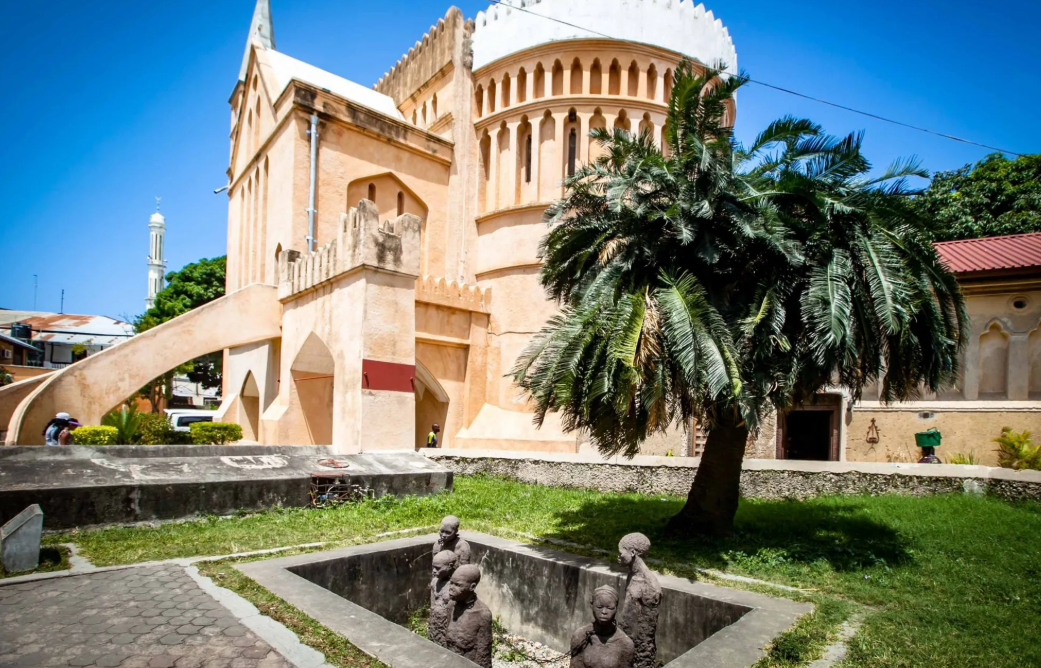
Toby has a suggestion for those opposed to the Church of England’s ‘Project Spire’ reparations plan to put £100 million into an investment fund to benefit those communities “affected by historic slavery”. Seeing as all the sceptical arguments so far have fallen on deaf ears, perhaps clubbing together to fund a trip to Zanzibar might do the trick. Here’s an excerpt from his Spectator column this week:
I’ve just returned from the East African archipelago, which was a slave trading hub in the 18th and 19th centuries, and was struck by how well-disposed the locals are to the British, particularly the Anglican church. On a family trip to a spice farm, our guide lit up when he discovered we were from the UK and told us that Zanzibar was far better off as a British protectorate from 1890 to 1963 than it had been under Omani or Portuguese control. He was particularly effusive about Edward Steere, the third Anglican Bishop of Zanzibar and a prominent abolitionist, who arranged for the purchase of the former slave market in Stone Town, Zanzibar’s capital. In its place he built a cathedral, cementing his status as a local hero. Admittedly, the C of E didn’t actually pick up the tab – the land and building were paid for by the Universities’ Mission to Central Africa. But the notion that the Church should pay reparations for its complicity in the slave trade would come as a shock to Bishop Steere.
We visited the Cathedral of Christ Church, often referred to as the ‘slave market church’, which stands as a monument to Anglican abolitionists. Steere himself is buried behind the altar, while beneath a window is a large gold plaque memorialising David Livingstone and “other explorers… who set free the slave”. A wooden cross made from the tree that grows next to Lake Bangweulu in Zambia, where Livingstone’s heart was buried, sits in the chancel.
Next to the cathedral is a small museum devoted to the East African slave trade that, among other things, pays tribute to the Royal Navy’s West Africa Squadron, which was established in 1808 to enforce the ban introduced by the Slave Trade Act a year earlier. A photograph in the museum shows the captain of a ship surrounded by freed slaves with an African child sitting on his shoulders. The only duff note is struck by the accompanying text which says Britain’s commitment to abolishing slavery was “ironic” given that it established the transatlantic slave trade in the first place. In fact, it was Portugal that first started transporting enslaved Africans to Europe in the 1440s, with Spain expanding the trading routes after colonising the Americas in 1492. Yes, the British dominated the trade in the 18th century, but we didn’t start it. On the contrary, we paid a heavy price to end it, with 1,600 sailors in the West Africa Squadron losing their lives in the 60 years it spent patrolling the seas, intercepting slave ships.
Visiting the museum was harrowing, particularly reading the witness accounts of the Arab caravans that transported the slaves sold by East African chiefs across vast distances, with many dying on the way. But it didn’t produce a sense of national self-loathing as slavery exhibits in English and Scottish museums are designed to do. On the contrary, it strengthened your patriotism. “I feel proud to be British,” said my most thoughtful son when we left the museum.
Worth reading in full.


Discussion
Comments
This week across the site:
To join in with the discussion please make a donation to the Daily Sceptic.
Profanity and abuse will be removed and may lead to a permanent ban.
In the UK at the same period and later we had wage slaves. 5 year olds up chimneys. Pre-teens working 48 hours plus a week in factories etc. An injury or an economic slump would mean being left without any means of support. I`m sure I must have a relative or two who suffered so where do I queue for my compo!
Quite.
‘Nuff said.
“..which says Britain’s commitment to abolishing slavery was “ironic” given that it established the transatlantic slave trade in the first place.”
Wrong. The Portuguese were the first European power to systematically purchase and transport African slaves across the Atlantic Ocean, initiating the large-scale trade in the early 1500s. The Spanish expanded on this is the 1600s.
Where did Great Britain rank amongst all the traders in African slaves?
Islam (High estimate): Approximately 14 to 17 million
Islam (Low estimate): Approximately 6 to 10 million
Portugal / Brazil: Approximately 5.85 million
Great Britain: Approximately 3.26 million
Spain / Uruguay: Approximately 1.06 million
Whereas both European and Muslim slave traders/owners purchased their black African slaves from other black Africans, the Muslims also kept up to 1.2 million white slaves, and those were not aquired through purchase from other Europeans but from capture.
and they castrated their slaves, hence the lack of anyone to demand reparations
“The British” were not involved in the slave trade – the East India Company and some British individuals were involved in it – and after abolition, illegally. It was not a national or Government policy and no slaves were brought to work in Britain – unlike Spain and Portugal where they worked in the fields and it was Government policy.
Some British people are involved in the international drug trade but that doesn’t mean “The British” or “Britain” is involved in this trade.
Spain shipped six times more slaves to the Americas than British slavers, most of who were worked to death. Yet we don’t hear of reparations being demanded from Spain or Portugal.
Both Spain and Portugal are the poorest countries in Western Europe while Germany, Netherlands and the Scandinavian countries are relatively wealthy and were not involved in slavery.
‘It was not a national or Government policy and no slaves were brought to work in Britain . . .’ Neither of those claims is true. Slavery in the American and Caribbean colonies was tacitly supported from the early seventeenth century. Encouraging the English slave trade (especially through the mechanism of the Royal African Company) was a policy pursued by both Charles II and James II. It could even be said to have been encouraged by Cromwell via his ‘Western Design’ initiative. Changes to the common law pushed through the courts after 1676 (google Butts v Penny) helped the trade flourish. Further incremental changes made the ownership of slaves possible in England, although on much shakier grounds and they were largely undone after 1689. Men and women certainly ‘owned’ slaves in Britain in the eighteenth century but – arguably – more by custom than law.
Our rulers thought nothing of owning slaves because they thought nothing of treating British peasants in a similar way. Labour shortages caused by the Black Death eventually changed the balance of power, and by the late 1600s the feudal system had been formally replaced by demanding rent, but the death penalty or transportation for minor crimes was still commonplace.
your entire post demonstrates that it was not official government policy – “tacitly supported”
Yawn. Your taking two words out of context and drawing a conclusion from them obviously isn’t an argument that is worth responding to, but nevertheless I will. I make it quite clear that whatever the case before and afterwards, it was official govenrment policy under Charles II and James II. As it happens the ‘big win’ that the British got out of the Peace of Utrecht, 1713, was the Spanish Asiento, the right to sell African slaves into the Spanish American Empire. Another example of government policy supporting the Atlantic slave trade. Of course, the 21st century Briton doesn’t want it to have been true of his country, but no amount of mythologising the past can change history.
I recently explained to a Guardianista friend something about the work of the RN East Africa squadron, based on Zanzibar in the nineteenth century. Her instinctive reaction? That we shouldn’t have been imposing our ideas on the locals or interfering in their lives. So many of the English appear to revel – absolutely revel – in post-colonial guilt. It surely imparts a warm glow of self-righteousness.
I wonder if that non-interference would extend to celebrating the culture of Barbary pirates in raiding the West Country coast for slaves?
Or celebrating sati in India?