

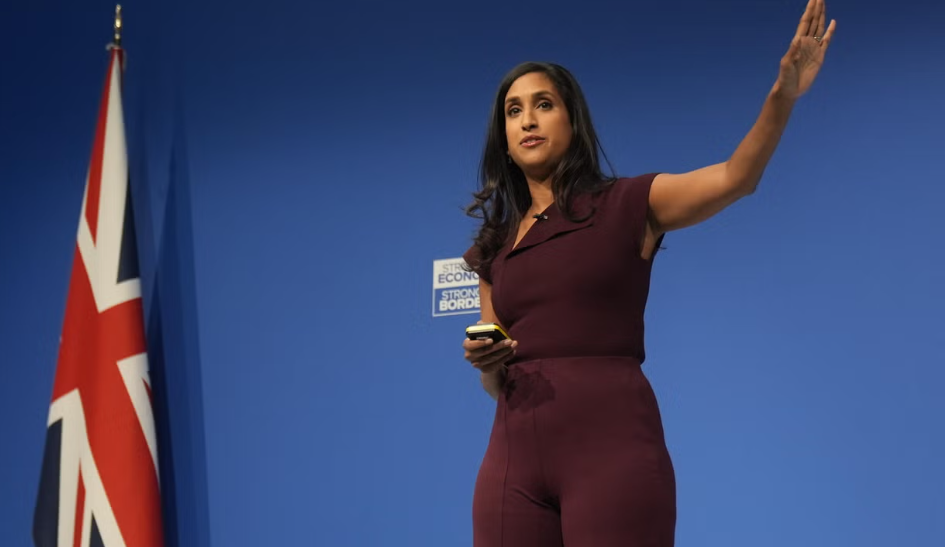
This week, Shadow Energy Secretary Claire Coutinho endorsed and wrote the foreword for Firm Foundations, a new paper on energy policy developed by the Onward think tank. On the surface, it’s a bold proposal that leads with some striking numbers: the paper sets out a vision for an “alternative policy pathway” that will save the country £320 billion between 2030 and 2050 in reduced electricity costs.
However, on reviewing the paper, it quickly becomes clear that Firm Foundations is a relatively meek exercise in harm reduction.
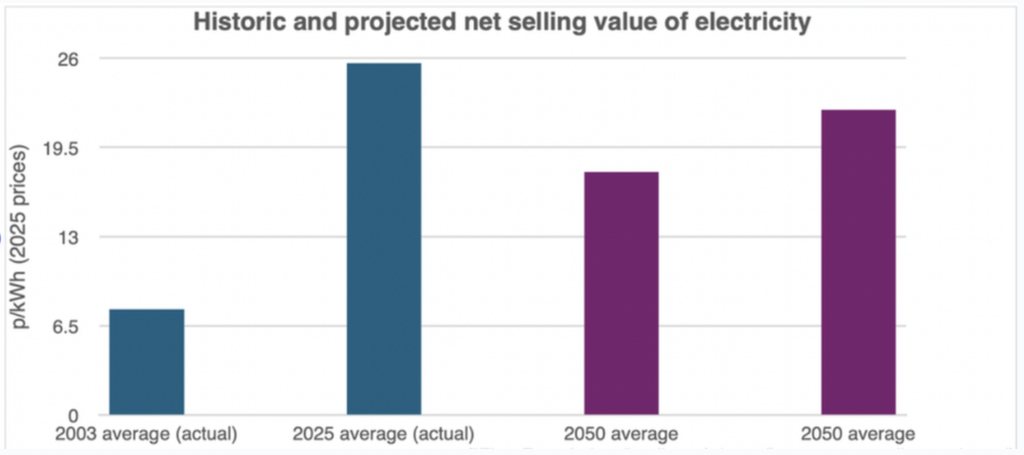
To understand this, we should zoom out to the overall trend in electricity prices over time. Between 2003 and 2025, the average net selling value of electricity from Britain’s grid rose by 233% in real terms: a kilowatt-hour of electricity rose from 7.7p in 2003 to 25.6p in 2025.
If we look to history, tripling the cost of a universal consumer and industrial input is normally the sort of thing that would delegitimise any regime. But rather than set out a plan to reverse this trend, Firm Foundations only targets a gentle reduction in prices from their current levels over the course of the next quarter-century. Taking the 2025 average net selling value of electricity as our baseline, it looks only to bring real prices down to 17.7p per kWh by 2050. By contrast, current Government policy should stabilise real prices at around 22.4p per kWh by 2050.
When Coutinho speaks of reducing the nation’s energy bill


Discussion
Comments
This week across the site:
To join in with the discussion please make a donation to the Daily Sceptic.
Profanity and abuse will be removed and may lead to a permanent ban.
Claire Coutinho is a very good performer in Parliament, always on top of her brief. Much better than Kemi Badenoch in fact. She knows that a raft of her fellow Tory MPs are still committed to Net Zero so she’ll advance slowly, which is sensible. She’s worth a higher status position in the shadow cabinet but may be too much of a threat.
Guido reported yesterday that Badenoch hopes to regain votes from people living in the south, who previously voted Conservative but have defected to Labour and the LibDems.
In other words, the kind of virtue-signalling, dripping wet lefties who supported the Party when it “talked Right and governed Left.”
So all the guff about the party changing and returning to conservatism is bollocks. They are standing in a wet puddle of their own making and have no intention of moving.
The Tories are as wedded to the Climate Doom as they ever were. They still want Net Zero but more softly, softly, just when they think the public won’t notice.
Komedy Badenough puts on a good show, but the people behind the curtain pulling her strings have not changed one bit.
The SDP’s projections for how much new generating capacity we’d need seem far too high. Admittedly we haven’t had a very cold winter since 2010 but since the start of 2025 maximum demand was 48GW. http://www.gridwatch.co.uk
AI will increase demand, provided electricity costs are low enough that the UK can be a major player, but by how much? A lot of our nuclear and gas fired power stations are approaching the end of their economic life and will need replacing fairly soon but how soon?
Projections from organisations such as the Climate Change Committee about how high demand will be in the future assume that the vast majority of heating and transport will be electric. Scrap mandates, subsidies etc. and only a small number of eco-worriers will have EVs or heat pumps so they won’t lead to a massive increase in peak electricity demand.
No news round-up yet today. After so much turmoil on the website I wonder what is going on.
I still have to login on my iPhone multiple times a day.
It turns our that Rod Liddle was right, the Social Democrats are more serious than either the Conservatives or Reform.
An excellent article with a more honest approach than I have seen from others.
And their polling numbers are, what?
Hardly ever heard of in any media that people listen to or watch. Their party leader has just resigned, he’s “done all that he can”.
I’m sorry to hear that. I’m not an SDP supporter, being firmly on the Right, but William Clouston is a decent man who debated respectfully and developed some serious policies. Perhaps the Clacton by-election – where the Uni-Party united to try and get a Bin elected – was just too much for him.
With regards to the Conservatives, Fool me once shame on you, fool me twice, shame on me. I just do not trust them, they are still filled with the same Lib Dem style progressive children of Blair MP’s and advisors. Kemi talks a good game, but rather like Labour she has to get the Party to go along with her, and I do not see them doing that.
Every proposed minor course adjustment will be subject to equally minor course readjustments without much ado. Radical changes make more lasting adjustments – but probably loose the support of the Wets, so I believe the paper has been ‘triangulated’ for internal Party consumption.
Remember when nuclear power promised electricity too cheap to meter?
Well the French are paying 16p unsubsidized with an ageing fleet they haven’t replaced, whereas ours is government capped (thus subsidised) at 26p and without communist level government price setting and production controls would be much higher, likely double.
China paying 5-6p, with massive coal but also with 63 nuclear reactors with 39 more under construction. They seem to know which way to go.
Ofgem can cap the price of a unit of electricity to prevent price fixing by the suppliers. The price cap reflects the cost of generating electricity, including the massive subsidies we pay for renewables. The only way in which the government is now partly subsidising electricity is because some of the obscene amounts of subsidies given to renewable generators has been moved from bills to government spending.
Ultimately it doesn’t matter where these subsidies come from we still have to pay them and they’re a drain on the economy.
Price capping IS price-fixing.
Electricity suppliers – retail – buy electricity wholesale from grid operator NESO. These prices are not capped, they are elevated and increasing due to the subsidies paid to wind and solar.
A market cannot continue where suppliers’ prices are capped, but the cost of what they supply isn’t.
Price capping (of anything) = shortages, guaranteed.
Which is why we are being softened up for power rationing.
But. There are two markets: the retail market – price capped, and the wholesale market distorted by subsidising wind and solar. Gas controls pricing about 90% of the time because it nearly always – has to be – in the mix due to intermittency of Ruinables.
Gas per MWh wholesale is around £70. Wind via the Contract for Difference scam, is guaranteed £128 per MWh. Wind then gets the £70 wholesale which is then topped up by NESO to £128 which gets passed on, so the true price of wind to retailers is £128 irrespective of the gas price. So it wouldn’t matter if the wholesale gas price was £0 – the consumer still gets screwed because of Ruinables.
Therefore retailers selling price is capped, but their costs are not = shortages. They won’t sell at a loss. Already a number of smaller ones have gone belly-up.
The liars have tried to blame gas for high prices and volatile global market prices, but the facts do not support this.
Nuclear is the most expensive way to generate electricity. Nowhere have reactors ever been built and run, or being built without money taken from taxpayers. China has a command economy so costs don’t matter.
The much delayed Hinckley Point C reactor has been awarded an inflation linked, lifetime wholesale price of £128 per MWh.
The formerly State-owned EDF the owner of the French nuclear fleet has now been renationalised. Why because it has to build a replacement fleet and as a private company could not raise the capital. So now the French taxpayer will pay – they paid for the current ones.
Nuclear is not cheap.
Hinckley C will be a European Pressurised Water Reactor. The only one that had previously been built was in Finland and was completed at least 5 years late and tens of billions over budget. Only the retarded minister who signed the deal with EDF knows why they wanted this design.
South Korea keeps building nuclear reactors using a different design at a much lower cost. With any major complex construction project the people in charge don’t get it right first time in terms of doing it efficiently and as cheaply as possible. They apply the lessons they learnt on one project to the next one and costs fall. South Korea has had at least one reactor under construction for at least 40 years, they can build one in a lot less than 10 years and, adjusted for inflation, each one they complete is cheaper than the previous one.
The French taxpayer paid for a lot of nuclear reactors and enjoyed decades of fairly low cost electricity. Nothing lasts forever so every power station has to be replaced eventually. Once built nuclear reactors are a lot cheaper to operate than gas fired power stations, a lot of the cost of the… Read more »
Total balls in a sling
Generation Cost (LCOE): The average construction and operating expense comes out to about $25.50 per MWh ($35,727 KRW) for domestic light-water reactors according to recent industry and OECD Nuclear Energy Agency data. Other market analyses place the broader levelized cost of generation around $70 to $75 per MWh. [1]
Long-Term Operation: For older reactors undergoing life extensions (such as the Kori units), the generation cost drops significantly—ranging from $21 to $36 per MWh—making it one of the cheapest forms of electricity available. [1]
Capital Cost to Build: South Korea maintains some of the lowest construction costs globally, with estimated overnight capital costs around $2,200 per kilowatt (kW) capacity, compared to over $6,000 per kW in the United States.
This is cheaperathan the capital cost of our crap onshore wind installs.
Adjusting course after The Titanic struck the ice-berg made no difference to the outcome. We are already sinking.
In the words of Kirk in the Undiscovered country
Kirk “Don’t believe them. Don’t Trust them!”
Spock “They are dying….”
Kirk “Let them die”
How the Conservatives still have any prospects after nearly 30 years of fxxxxxg the UK absolutely blows my mind. They did all of this! Every horror you can think of from Net Zero to lockdowns to cultural Marxism to communist level taxation, when they said they would do the exact opposite, it was them!
Does the average voter have the memory of a goldfish?
While Camoron’s “Conservative” party were in power for 14 of the last 16 years, the real damage began with Tony B.Liar and George Soros meeting in April 1996 and agreeing to “green” policies to raise the cost of energy and pump the subsidies to organisations that Soros favoured. Mad Red Marxist Ed Miliband was chosen to do this by B.Liar and hence the Climate Change Act 2008.
Naturally Camoron carried on with this because of the Lib Dumb coalition and his and Osborne’s admiration for B.Liar.
Too true! The Conservative Party must never be allowed near the seat of power ever again. A nefarious party that abandoned conservatism to serve the interests of the globalists.
Or any other of the options on offer.
To be fair it’s a welcome move in the right direction, but it is still an exercise in triangulation rather than a root and branch reform.
That said don’t let the best be the enemy of the good.
The overton window is shifting.
Triangulation and fear of the overton window is exactly why Britain is on the precipice of a disaster.
If you don’t recognise how bad the problem is then you will be content with minor incremental changes and then just crossing your fingers.
Muddling through doesn’t cut it in a crisis.