

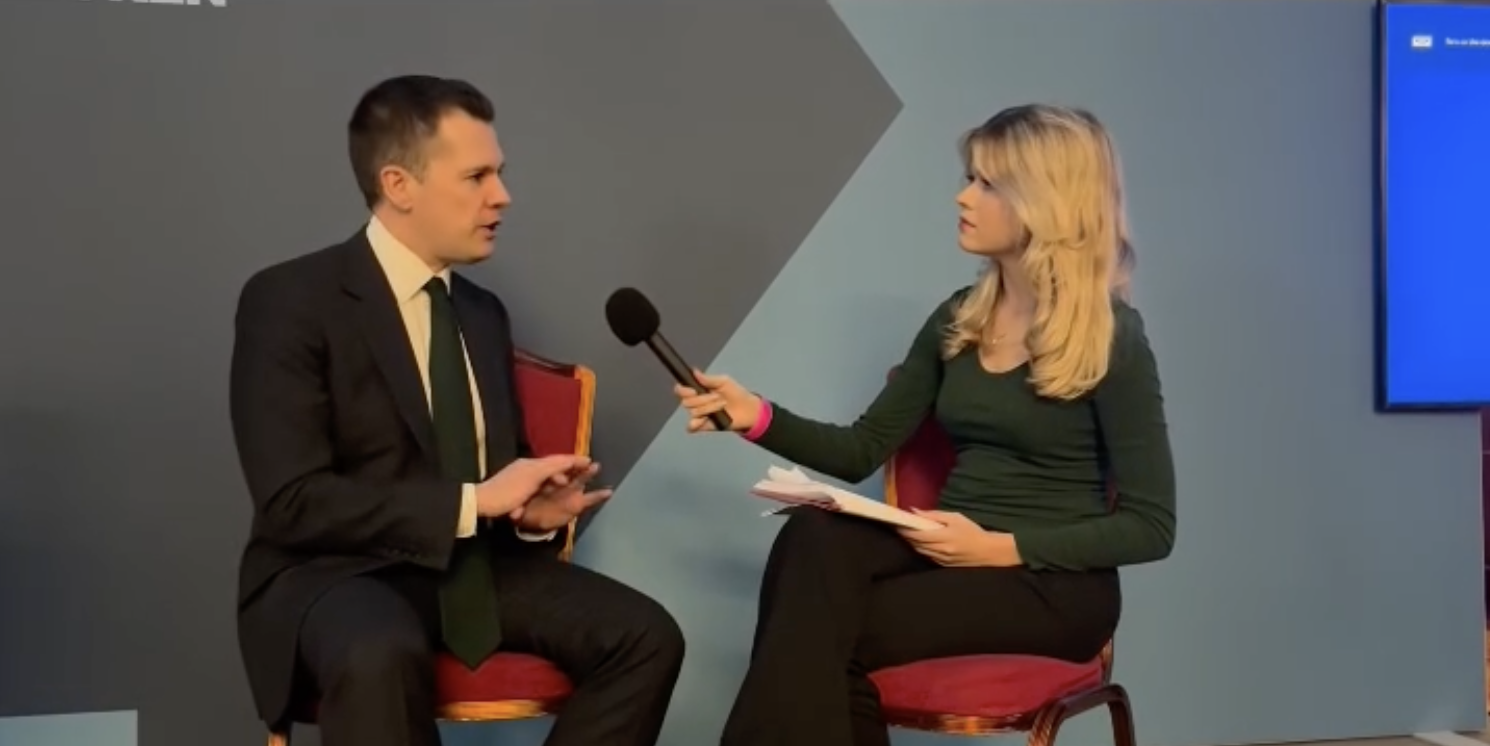
Nobody tells you when you become part of Westminster. There isn’t one particular moment when you suddenly think, right, I’m in now. You just slowly become immersed in it. You stop getting lost. You begin to know where certain people will probably be depending on the time of day. You know which pub everyone will go to after an event. You start recognising people, then they begin recognising you. Eventually, you realise you’ve become one of those people who can’t walk five minutes from Westminster station without stopping to say hello to someone.
I remember first walking through the doors of the News UK building. I was there on work experience and, despite being meant to be there, I still felt slightly like I wasn’t. Upstairs in the dressing room, I found myself making awkward small talk with presenters I watched daily. Afterwards, I went up to the gallery and watched the production of a programme I had only ever seen from home. It was strange seeing how it all worked from the other side. A couple of years later, that same programme is one I now appear on most weeks. What feels strangest is that I no longer really think of those people as presenters. I just think of them as them. The one who’s always late. The one who never seems to be without a coffee. The one who’s always a little bit grumpy. Somewhere that once felt completely out of reach has become somewhere that feels familiar and comfortable.
After my first reporting event, everyone headed to the pub. I assumed we would talk about the day’s politics. Instead, I got a crash course in Westminster itself. Within an hour, I had heard about decades-old feuds, people who refused to be in the same room together and enough rumours to make me wonder whether anybody in Westminster had ever successfully kept a secret. One person would tell me somebody was one of the best people they had ever met and one of the rare people I could “trust”. Five minutes later, someone else would tell me the exact same person was evil.
These were people I had watched and sometimes even looked up to. Suddenly, I was hearing about their scandals and the most ridiculous rumours imaginable.
It was a hell of a lot of information to take in.
I remember sitting there genuinely shocked and not knowing how to respond, while everyone else carried on drinking as though this was all completely normal.
Little did I know that practically everybody has skeletons in their closet.
The problem is they rarely stay there for very long.
To be fair, some of it was meant as a warning. Afterwards, one of the people I had met sent me the phone numbers of several women in politics whom I could contact if I ever needed anything. It was done, as they put it, to “protect me”.
Everybody says they hate Westminster gossip. They just never seem to mind adding to it.
You also start learning the geography of Westminster.
A friend once explained the pubs to me. The MOG is the think-tank pub. The Two Chairmen is for journalists. The Westminster Arms is for politicians and staffers.
I laughed, but they weren’t far wrong.
Only a few days ago, I finished at GB News at around seven and popped into the Westminster Arms to get some water before going home.
I bumped into a friend. Then another group. Then another.
Three hours later, I finally left, having somehow been convinced to travel to Clacton the following day for the by-election because everyone else was going and it would apparently be fun.
I had only gone in for water.
Every now and again, though, there is a glitch in the Westminster Matrix.
A friend told me about the time James Corden ran into the MOG to get a bottle of water because he was attending an event across the road. Somehow, in a room full of politicians, journalists and think-tank people, James Corden was the one who seemed out of place.
I remember the first time I watched Prime Minister’s Questions. I was behind the glass with a school group, looking down into the Chamber. It felt like another world. You were close enough to see everything, but still separated from it. A spectator looking in.
A couple of years later, I found myself back in the same Chamber, this time sitting in the Gallery directly above the Prime Minister.
There was no glass.
MPs I had got to know over the previous two years looked up, recognised me and gave me a wave.
It sounds small, but it felt completely different. I wasn’t looking into this distant political world anymore. I felt part of it.
Another thing I hadn’t expected was that the most famous politicians were not always the most interesting people.
Often, it is the people behind the scenes. The people who have worked for senior politicians since they were 16. The people needed to keep the whole system moving.
It is still very much a man’s world.
Some of the best advice I have received has come from women who quietly took me under their wing. They warned me about certain people and explained the unwritten rules.
Others have reminded me how competitive Westminster can be. Some will genuinely want to help you. Others will see you as competition.
You learn that surprisingly quickly.
People also assume that because you are young, you are impressionable. Westminster is full of people willing to tell you what to think, whom to trust and which side you should take.
Listen to everybody. Believe not quite as many.
Just don’t let them mould you into what they want you to be.
Sometimes Westminster can feel claustrophobic. It can be brilliant that it feels almost like a town, with everyone knowing everyone.
But if you mess up, everyone knows. Rumours are Westminster’s favourite currency.
I sometimes escape to a little Greek café tucked away down one of the alleys. It is one of the few places where I know I am unlikely to see anyone from the Westminster Bubble. I practise my Greek, have a coffee and breathe for a bit.
Then I go back into it.
I’ve learnt a lot over the past two years in Westminster.
More importantly, I’ve learnt that Westminster is nothing like it looks from the outside. It’s smaller than people think, faster than people think and far more connected than most people realise.
I’m still learning.
But I’m not convinced anybody ever completely works Westminster out.
I think they just get better at making it look like they have.
This post first appeared on Ellie Hodges’ Substack. You can subscribe here.




Discussion
Comments
This week across the site:
To join in with the discussion please make a donation to the Daily Sceptic.
Profanity and abuse will be removed and may lead to a permanent ban.
Really interesting article.
Ellie, I have been watching you and your various appearances on Talk and more recently The Mike Graham Show and UKLiveOnline programmes. You are articulate and always speak common sense views not usually heard from someone of your generation. You do not go along with the usual narrative of ‘right-wing bad, left wing good’ It is clear that this is because you did not go the usual route of 6th Form and University preferring instead (as I understand it) to tackle your ambitions to be part of the media head-on. Thus you have not been brain-washed and have a great future ahead of you. Your recent hosting on your own show on UKOnLine was a master class in how someone young and comparatively inexperienced can succeed. Good luck you.
I don’t know who you are Ellie Hodges – my fault doubtless as I don’t get out much- but answer me this: what proportion of MPs seem like useful idiots who believe the claptrap they spout and how many are just evil, manipulative liars? Or is it hard to tell?
I always fall back on what political researcher/author and blogger Dr North said when he entered Bubble World. From the outside he used to respect these people but once inside he was amazed by just how thick they all were and that they run scared of anyone who has intelligence. If you want an easy proof of this, consider how often when the subject of the EU pops up they talk about whether we should rejoin The Customs Union. It really is an insult to kindergartens everywhere to say that knowing that The Customs Union is for EU Members only is down at that level when it is really lower.
All workplaces are like this in some way, the more political they are the more toxic they can be.
If possible ensure your real friendships are outside of work.
Cough. Let’s see how that advice holds up over time.