

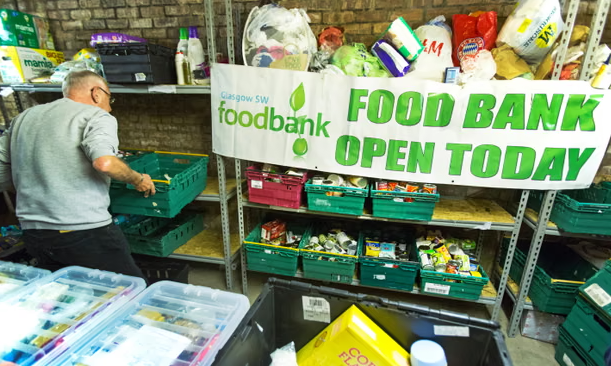
“Frightening!” It was not the response I expected when I asked my 80 year-old-friend how she’d got on at her local food bank. “My van was shaken by a group of angry men who didn’t get what they wanted. It was very frightening.” Veronica was describing a volunteering session in Peterborough. She elaborated: “We handed over the usual sort of package but they were asking for very specific things we didn’t have. They got very angry and started shaking the van. I had to hold on to the ledge and shook myself for some time afterwards.” She added, “I mean it was all getting a bit silly anyway, groups of men in taxis were arriving at the food bank van with their vouchers.” Veronica was self-aware enough to recognise that perhaps she was wrong in her expectations of who needed food banks. “Perhaps these men were hungry,” she admitted. “They didn’t look it though and weren’t very nice.”
Veronica’s front line experience is unfortunate and one would hope rare. We as a country are generally encouraged to hang our heads in shame at the fact that, according to the Department for Work and Pensions, 4% of individuals in the UK live in a household where a food bank has been used for food in the previous 12 months. The most well-known of these initiatives is Trussell (formerly Trussell Trust), which distributed around 1.1 million emergency food parcels in 2015. By last year, this had increased to 2.6 million.
However, in an age when state statistics are often at odds with our general ‘lived experience’ it is worth pausing to check in on the business of British food banks: who is providing them and why? Who is accessing them and why?
There seem to be two different types of food banks: local community schemes whereby a group of volunteers or churches partner with supermarkets and local businesses to reduce food waste, and a more organised effort by dedicated charities. The former are generally open to anyone who is happy to take out-of-date food. The latter require tokens and referrals from Citizen’s Advice, GPs, council welfare officers, social workers and migrant/refugee/asylum support charities and caseworkers. It is the latter more professional operation that Veronica volunteered for.
This past term I have supported a secondary school student who lives in a house with bare floorboards and wallpaper peeling off the walls. The house and her clothes smell headily of urine. She has been out of school for a year and I am attempting to encourage her to return in September. We visit a coastal town library with a view to catching up on reading and writing. Every morning at the library there is a bustling ‘community fridge’ staffed by kind-hearted people who want to help the needy. As I slowly read with my student I watch a procession of elderly folk visit the community fridge, have a friendly chat and walk away with a cauliflower, baguette, bag of carrots and joy of joys – a full piece of cheddar. No tokens are required, the food is given by local supermarkets in an effort to reduce food waste. Every week, I encourage my student to go home with something – if anyone is in need of free food it is this paper thin student and her family. She absolutely refuses, explaining that only “nitties” (crackheads) go to food banks. I of course take whatever is seemly, generally a bunch of bananas and loaf for the freezer.
She is by no means unusual. Most of the families I support have a bafflingly expensive approach to food and eating, preferring meal deals to homemade sandwiches, takeaways rather than homecooked and Monsters bought in bulk on trays of 24. I have signposted numerous families to various outlets including individual churches that give away free food and have without fail been greeted with a disgusted: “No thanks, we’re not skanks.” Statistically speaking such families are poor but many turn their backs on well-meaning food bank initiatives. The middle and upper classes have no such qualms. Another friend from Lancashire speaks warmly of their local ‘Wall of Food’ where Waitrose offloads its out of date produce and 4x4s drive up early to bag the best bits.
With such anecdotes, and the truth that it is already possible to eat well for little money if you are prepared to cook from scratch, it ought to be possible to query the very basis of the Food Bank story. According to Trussell:
Not so long ago, food banks were not needed to the extent they are today. Our social security system was created 80 years ago to protect people from hunger and hardship, and for decades after, people were a lot less likely to need a charity’s help for the essentials.
(There could of course be others explanations for the rise of food banks than insufficient state welfare: food banks didn’t exist so people didn’t take advantage of them; people were taught to cook properly by their families and at school; obesity was less prevalent so expectations about food essentials were different – other ideas welcome!)
It seems pertinent to raise the possibility that some larger food bank charities may have motivations other than feeding the hungry and sharing surplus food. As glimpsed by Veronica, it could be argued that certain food bank operations form part of the industrial charity complex that confects need in order to make a political, Left-wing, point.
A quick glance at Trussell, for instance, reveals a charity that has been tremendously successful in raising money for its primary aim of delivering free food for the hungry. Its latest annual report states Trussell is in “1,400 food bank locations, supported by 40,000 volunteers, 12,000 churches, hundreds of thousands of community groups and schools, and millions of people around the UK”. Its obvious well-intentioned kindness has struck at the nation’s heart strings. Since 2018 its income has ballooned nearly 10-fold from £7.3 million to £62.8 million in 2025. But in that time the number of foodbanks has only increased by about 10%. But what has certainly increased is the number of highly paid staff: in 2022 it was reported there were six employees on over £60k . There are now 190, with 43 earning over £100k.
Relying as it does on 40,000 volunteers, it begs the question: what on earth are all these highly paid staff doing? A quick read of its latest Annual Report reveals an awful lot of left wing political lobbying. It states:
Since 2022, Trussell has been working with the Joseph Rowntree Foundation to call for an Essentials Guarantee within Universal Credit, which means that the basic rate of payment will at least cover life’s essentials – including food, utilities and vital household items – and that support can never be pulled down below that level.
It seems that Trussell’s approach to ending the need for food banks is the failing idea of more state spending, rather than personal and family responsibility. The Annual Report celebrates how the charity campaigned against Starmer’s welfare reforms:
In March 2025, the UK government announced its proposals to cut disability support payments – and Trussell supporters across the UK were swift in calling for voicing their disapproval. Between March and July, over 38,000 emails were sent by our supporters to their local MP, urging them to rethink the government proposals.
Unsurprisingly, Trussell is against any cuts to Universal Credit and against the two child benefit cap:
As a result of these efforts, the UK government made significant changes to its plans. These included removing all cuts to Personal Independence Payment (PIP) and committing to producing future plans for PIP together with disabled people. It also kept in place positive measures to introduce an above-inflation increase to the basic rate of Universal Credit.
Trussell continues to spend heavily on food banks – £42.6 million, representing 58% of its total expenditure. Increasingly, however, it is spending large sums on political lobbying: approximately £17.9 million – 24% of its expenditure. Are members of the public who make such donations aware of the extent of Trussell’s Left-wing campaigning?
Incidentally, Veronica resigned from her volunteering post.
Trussell was approached to explain what proportion of donations were spent on food banks and what on wider lobbying concerns, but did not respond.
Mary Gilleece is an education support worker and her name is a pseudonym.


Discussion
Comments
This week across the site:
To join in with the discussion please make a donation to the Daily Sceptic.
Profanity and abuse will be removed and may lead to a permanent ban.
Trussell didn’t respond to questions because they were seen as threatening some of those well-paid jobs. The main concern of any organisation is the protection of the organisation. Any other concern or aim must wait in line.
Just who were these angry men I wonder….
‘men’ in taxis. No idea.at.all, mate. Cornishmen? Orcadians? Scillonians?
Perhaps, if they paid for food instead of using taxis?
Likely, that concept was what made them angry.
Any good cause will become a business and turn into a racket.
More grift.
“Charity”, huh.
I thought the food bank queues wer supposed to be made up of nurses.
Anything which is provided “free at the point of need” will be abused by some people.
Trussell is just another in the politicised Charity sector, whose main function is to push for, and promote, Fabian Policies.
To me it appears that food banks are the living version of the Peter Sellers film Heaven’s Above in which a new vicar created a food bank. In the end even her ladyship was sending her chauffeur and the Rolls round to the church to collect her free food entitlement. Where I live we know of folks who use the local food bank for comestibles and the co op for multipacks of booze and ciggies. With all the non cash extras that come with universal credit such as free council tax they are often better off than working people.
You don’t need to be an economics PhD to understand that zero cost of supply leads to infinite demand.
Precisely.
If virtue signallers set up a stall handing out free £50 notes, I predict they would be very busy indeed.
But the Grauniad and Beeb would joyfully report it as a demonstration of financial unfairness in society.
Yet another charity scam with staff being the principle beneficiaries.
It usually happens. Charities, NGOs, Quangos, local authorities, devolved administrations and government departments all change their focus away from what they should be doing and spend as much management time as their imaginations will allow on political campaigning.
I do enjoy a “lived experience,” it’s the unlived experience I’m wary of 😀😀
A very important and timely article by Mary Gilleece. I hadn’t heard of the large Trussell “charity” with so many staff being paid high salaries while thousands of kind-hearted, well-intentioned volunteers help out for nothing. I only know about the local community food banks which do a brilliant job of offering good quality free food, and other useful household items, to local people who come to the community centres to see what’s on offer that week, and often sit down to have a coffee and chat with other locals, or join in the various games and activities for adults and their children. Local supermarkets regularly donated their leftover freshly baked bread at the end of the day to a church nearby, which also housed a community centre once a week, along with delicious baked pastries and even cut flower bouquets that would be past their sell-by date on the morrow.
I was shocked when one volunteer leader who had been toiling away cheerfully for years told me that during the Covid Lockdowns, she had organized local volunteer drivers to take food parcels to elderly and housebound villagers throughout the surrounding rural area, and she was upset by the ingratitude and… Read more »
The entitlement reminds me of the comment, “ I’ve got rights “, something that I heard frequently whilst living on the council estate where I spent my first twelve years, in the late fifties and early sixties. Never did I hear, “ I’ve got responsibilities “. To be fair, there were very few families where the father wasn’t employed, but that comment encapsulated the attitude of some.
I often wonder what people who claim they can’t afford to feed themselves and their kids are spending their benefits on. I bet loads of them have an expensive monthly mobile package that includes loads of data, a separate internet package and quite possibly subscriptions to Netflix, Sky sports etc. It’s quite likely they spend some of their benefits on booze and maybe drugs.
Maybe a lot of the benefits people get should be given in the form of vouchers for food, energy and limited internet access to help with job searches/filling in application forms plus a small amount of cash. They’d need to be a system that means food vouchers couldn’t be used to buy high value items such as large joints of meat that could then be sold on to buy drugs/alcohol. People would also have to show photographic ID when using the vouchers to stop them selling them. This would help ensure they fed their kids properly before buying luxuries.
The bleeding hearted liberals would say it’s demeaning for people to have to identify as being on benefits when they do their shopping. The answer to this is, hopefully it is and not wanting to feel demeaned… Read more »
They don’t need to be identified by vouchers. Their benefits could be paid via a card which can ONLY be used for food products.
Every act, and I mean every single act of structured ‘kindness’ will be abused as an opportunity by bluffers and chancers. The ‘Kind People’ always seem to imagine that only people in need will come for help, and they will be grateful for what they are given. Bullshit. The Foodbank I regularly drive past has a queue of people who are fatter and better dressed than me. You have to ask which side is actually feeling the benefit, the people giving or the people taking.