


In July 2023, Georgina Rannard of the BBC ran a ‘scientists say’ story stating that the Gulf Stream system of warm ocean currents “could collapse as early as 2025”. It would be difficult to find a more tosh-filled tale of climate bunkum so perfectly constructed to fill the population with alarm and a willingness to accept the collectivist Net Zero fantasy. All the recent evidence, other than the findings of rigged computer models, is providing conclusive proof that the Gulf Stream is currently stable, although subject to higher-than-expected natural variations in what are often very short time intervals.
For 20 years the RAPID-MOCHA-WBTS Array has measured the movements along the Atlantic Ocean at 26°N. A number of submerged stations have collected large amounts of data on the currents that bring warm waters from the Gulf up to the Arctic and return them cooled, heavier and saltier back to the south. Alarmists and Net Zero fantasists have long argued that humans interfere with this process. In unison they wail (perhaps next year!) that a ‘tipping point’ could be reached where the currents reverse and bring ice age weather to countries in the northern hemisphere.
But findings from computer models that have produced countless The Day After Tomorrow headlines are being rendered increasingly worthless by the actual RAPID data. In fact, there has been a largely unannounced pause in any weakening of the Gulf Stream – also known as the Atlantic Meridional Overturning Circulation (AMOC) – since the early 2010s. Before that, and going right back to the start of measurements in 2004, the strength was generally relatively high, but there was a substantial weakening between 2009-2010. Such was the scale of this temporary weakening that the 20-year record has been skewed to show a 6% decadal decline. But RAPID has shown that sharp changes on a daily to inter-decadal period are the norm rather than exceptional. All of this is likely to be due to natural variation – what is often referred to as ‘noise’ – rather than any human cause.
Many of the fluctuations appear to be driven by changing air currents rather than deeper water formulations alone. These findings are starting to fundamentally change the way scientists understand the operation of the AMOC and mean that single or short-period snapshots are inadequate in measuring long-term strength. Needless to say, computer models are simply not up to the task of separating out any noise arising from the natural variability.
The scale of the natural variation can be truly astonishing. The RAPID observations from 2004-25 show a weakening of 1 Sv per decade in the AMOC. This is oceanographic-speak for a volume of water transported per second – 1 Sverdrup (Sv) equals one million cubic metres of water. The AMOC has an average strength of around 16-18 Sv, so the 20-year 6% average decadal decline is measurable but not necessarily significant given the enormous outlier recoded around 2010. In fact, RAPID has found that the AMOC can vary by several Sverdrups over months to years. The decline in 2009-2010 saw a 30% weakening which, since that time, has been restored. Some idea of the enormous changes discovered can be seen by comparing the 2009 Sv figure of 14.6 with the 18 Sv flowing in 2018. The one cause behind this huge change we can confidently rule out is humans using hydrocarbons.
The latest RAPID data show strong years in both 2023 and 2024, with flows around 17-18 Sv. Both these years have witnessed some of the highest flows recorded over the last two decades.
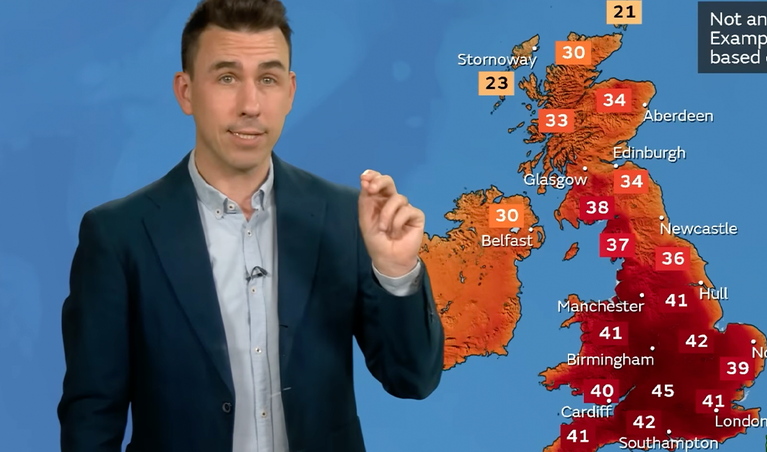
As with much climate science, a 20-year period of observation is a useful start but a clearer picture accounting for natural variation only emerges in a much longer time frame. The same principle applies to temperature measurement. In the world of climate Armageddon hype, the periods used to suggest long-term global warming seem to get smaller by the day. In the UK, it is by the day, hence the constant panic generation whenever the summer temperature rises above 30°C. This of course is why the scientific process has been largely trashed over climate. Debate is unwelcome, often penalised, since the matter is ‘settled’. Implausible proof is claimed from computer models running all manner of pseudoscientific attribution tales of bedwetting doom.
But away from clickbait Gulf Stream hysteria, some scientists are using RAPID’s growing volume of valuable data to increase understanding of the AMOC. In 2024, Dr Sang-Ki Lee, a Miami-based oceanographer working for NOAA, led a paper that observed a pause in any AMOC weakening since 2010, despite the growth of computer models projecting catastrophic anthropogenic decline. Despite these common modelled declines, Lee et al. notes that observations show “remarkable resilience” for the AMOC. Within any reasonable margin of error, it was found that the strength of the AMOC has been stable since around 2010. Looking forward, the authors suggest natural variation will keep the trend stable for several years to come.
There has been a pull back on the collapsing Gulf Stream scare of late. Computer model findings still broadcast plenty of human involvement, but genuine scares only have real legs when they are based on actual scientific observations and facts. The models assume that melting sea ice in the Arctic caused by humans burning hydrocarbons will freshen the water and interrupt the overturning flow to deeper waters. In a recent article published in Science, Susan Lozier, an oceanographer at Georgia Institute for Technology, observed: “That paradigm isn’t holding up.”
The Lee et al. paper refers to an underlying anthropogenic weakening produced by modelled suggestions. But RAPID provides actual proof that natural variation is far more important in determining how the Gulf Stream behaves. Another Net Zero scare bites the dust.
Chris Morrison is the Daily Sceptic’s Environment Editor. Follow him on X.



Discussion
Comments
This week across the site:
To join in with the discussion please make a donation to the Daily Sceptic.
Profanity and abuse will be removed and may lead to a permanent ban.
One minute we are all going to be fried alive, the next frozen to death.
I can’t keep up. I do wish they would make up their minds so I know how to kit out my wardrobe.
So: higher-than-expected variations based on 20 years of observations.
Here’s a radical thought: Maybe what some currently consider high variations are actually normal and the start of the recorded data is unusually uniform? Maybe that’s what needs explaining?
Oh Hell! I just gave them another stick to beat us with.
And in news to be ignored by the legacy media, the Greenland summer ice melt has not started as yet and is around a month late. In fact, with the jet stream running with Rossby Waves, the warm stream of southern air we are getting is balanced by the cold wet air flow over Greenland bringing more snow not a melt.
The high arctic is the coldest it has been in early July since modern records began in 1958.
Cap Allon at https://electroverse.info keeps track of all the cold things happening, of course these are rarely mentioned in any mainstream media.
“… the Greenland summer ice melt has not started as yet and is around a month late.”
A pregnant pause?
Guys, I’m confused. Could somebody please help…
BBC News: “Why heatwaves hit women harder”.
It says: “Biologically, women’s greater risk comes down to two things: the natural rise and fall of our hormone levels and our body’s response to heat, which are different to men’s.”
I thought gender was just a social construct.
Now they tell me it’s biological.
You don’t know who to believe these days!
I am disappointed that the BBC has not looked at how hot weather affects the 100 plus genders that they think exist.
It’s because men evolved in the tropics, and women evolved in the arctic. Or maybe men are from hot Venus, and women from cold Mars.
This is down to sex, not gender. Biological reality follows the first, not the second.
As far as I’m concerned, for human beings the two are the same.
For about 50 years of my life, gender meant grammatical gender. That idea has served me well. I think I’ll keep it.
Indeed, but for a lot of people this concept has been disrupted by idiots.
Hence I use the word sex so that there can be no confusion.
The answer, as always, is that everything is the fault of white, middle aged, middle class men. Now, what’s the question…?
I thought there was no difference between women and men physiologically or physically which is why anything a man can do – like fighting in the army, policing the streets, fighting fires, etc – a woman can do too. Women can do men’s sports – but apparently men can’t do women’s sports… because reasons.
Gender is an expression used in language to identify different types of nouns – masculine, feminine, neuter usually in European languages, but more in other languages, and ensure correct syntax is used. It has no meaning in biology.
If there is gender in Humans and it’s a “social construct” it must also be a social construct in tulips, avians, giraffes, lions, etc. Currently the tulips I have in the vase in the living room are identifying as daffodils, although one alternates between identifying as a rose and a sunflower.
Grammar has gender; biology has sex of which there are two determined by a biochemical reaction at the moment of fertilisation.
“The same principle applies to temperature measurement. In the world of climate Armageddon hype, the periods used to suggest long-term global warming seem to get smaller by the day. In the UK, it is by the day, hence the constant panic generation whenever the summer temperature rises above 30°C. This of course is why the scientific process has been largely trashed over climate.”
Beautifully put. The whole thing claims to express long-term trends, but is simultaneously attuned to a media and population with the emotional stability of a 2-year-old. “I’m hotter than an hour ago – CLIMATE CHANGE!”
Also the geographic area gets smaller. UK’s “average” is measured at a single weather station that doesn’t exist.
Cornwall is eight degrees cooler than London these days, the gulf stream demise isn’t working too well.
The truth might be closer to “WMO Class 1 weather station correctly shows Cornish temperatures; WMO Class 5 station in London – sited on a runway at Heathrow – shows 8deg higher”.
Good to see that there is some real scientific work being done. Keep calm and carry on is a term that is out of fashion in organisations like the met office, though.
A semi related story on the beeb west country news yesterday was about the amount of cash changing hands at Brixham market, on account of Spanish dealers buying Octopuses, which have migrated north recently. There is more demand for it there than here at present.
Good for Brixham – it certainly needs some economic support.
“tosh-filled tale of climate bunkum so perfectly constructed to fill the population with alarm and a willingness to accept the collectivist Net Zero fantasy“ is of course the point of the BBC. Never let facts or uncertainty get in the way of declaring a crisis.
Trends need to be measured probably over millennia, many hundreds of human lifetimes to really spot the outliers and allow for the noise.
Even a million years is a small window, and who’s to say there is any discernible trend(s) over any timeline.
There are of course known cycles like the Milankovitch cycles, and “possibly” solar cycles, but when you’ve only had the ability to measure something for 20 years, or 150 years, how can you possibly attribute anything over those timescales as “normal”.
Right now it is fairly hot, difficult to deny that, but the hotter it gets, the lower my barometer pressure gets, whichsuggests this is not normal.
Last weekend, when the temperatures fell a bit, the barometric readings were where you expect them to be. I have date stamped photo’s to prove it, and now again, pressure has dropped into the “changeable” 1010-1020 mm range, not the sunny 1030+ range.
I agree, and I also think this is on point. I particularly like the attention to detail with the ‘English Barbers’;
”I was 15 heading towards 16 during the summer of 1976. These funny reflections are on the money. Labour’s Denis Howell was appointed Minister for drought, but after the weather broke in September & it rained for 3 months, he was appointed Minister for Floods.”
https://x.com/daveatherton/status/2075245533824749640