


The Atlantic hurricane season, which officially ended on November 30th, was quieter than normal, with five hurricanes compared to a long-term average of 7.2.
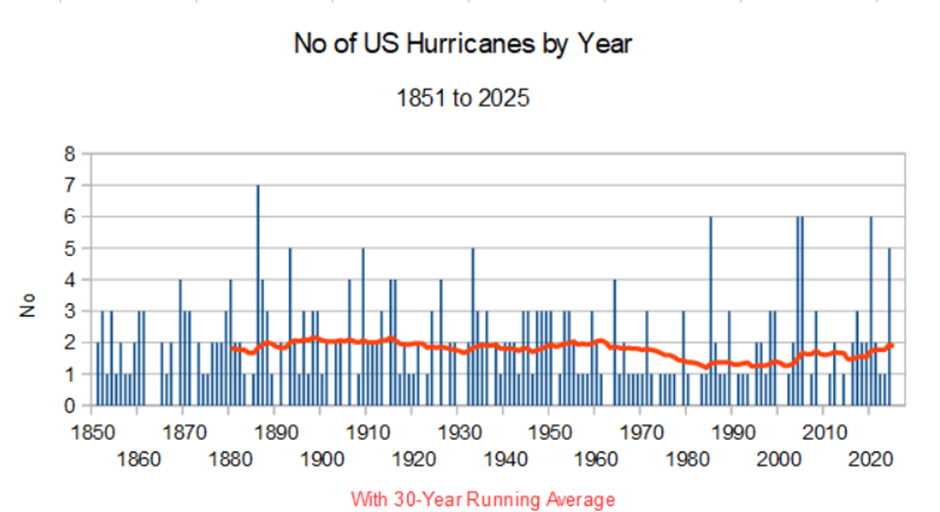
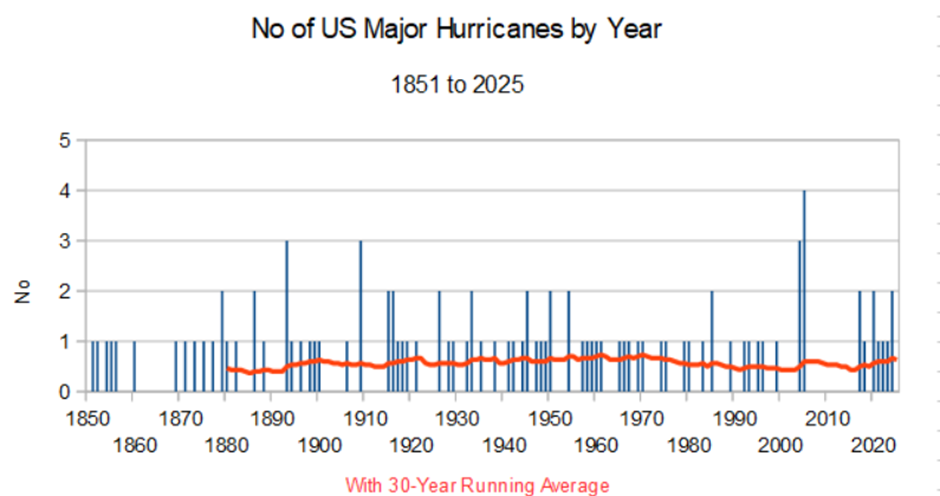
By far the most complete and robust data we have for hurricanes are for those which have hit the US coast. The US Hurricane Research Division, which is part of the Federal agency NOAA, has data going back as far as 1851. According to its records, hurricane data are pretty reliable since the 1880s, when the coastline became settled.
No Atlantic hurricanes at all have hit the US this year. The graphs below offer the strongest evidence of all that there are no long-term trends, either in the frequency of hurricanes or their intensity. (Major hurricanes are Cat 3 and stronger – these show no increase either.)
This is in marked contrast to the myth regularly peddled by the BBC and others that hurricanes are getting more powerful. It is worth pointing out in this respect that the strongest hurricane on record to hit the US was the Labour Day hurricane in 1935. The second most powerful was Camille in 1969 and the third was Andrew in 1992.
As far as the Atlantic basin is concerned, we have only had reliable data since comprehensive satellite coverage began in the 1980s. It was even later than this that hurricane hunter aircraft became robust enough to fly into the middle of the strongest hurricanes for hours on end.
The hurricane maps for this year and 1925


Discussion
Comments
This week across the site:
To join in with the discussion please make a donation to the Daily Sceptic.
Profanity and abuse will be removed and may lead to a permanent ban.
The answer is, as always, “MONEY”.
“So why, as recently as two months ago, did the BBC weathergirl, Sarah Keith-Lucas tell BBC viewers that “the frequency of very intense hurricanes such as Melissa is increasing”?”
Er….. because she’s a lying toe rag like the rest of her BBC colleagues.
This sounds like they wish to imply there is weak evidence. However, Paul Homewood’s article does not go into this.
I suspect they have nothing credible but wish to plant the idea that if they get enough funding they’ll be able to find something.
Yes but no but yes but no but… climate change will make it worse in the future.
The answer to your last question is because the BBC peddles its settled view of the world.
In addition, weather forecasts have moved from fact to entertainment. presenters are so excited when forecast temperatures for a day ahead are above average but they are brief and disheartened when it is cold.
It would be interesting to compare weather forecasts with outturn. I suspect there is systematic bias towards higher temperatures and extreme weather.
A newsworthy story is valued more than a factual exposition?
It depends what newsworthy means, in a sane world it means interesting and true but of course the MSM have long abandoned such an approach to news coverage.
Yep I remember when we lived in the Dales John Kay spent all night at Hebden Bridge in the usual ghoulish BBC fashion awaiting a flooding disaster. The disappointment in his report when when F all happened was priceless.
The nonsense is reinforced all the time by the BBC propaganda which 80% of the population believe and trust. So much so that they dress according to the BBC forecast (I know weather is not climate) and look amazed as it pours with rain and they have no Mac and umbrella.
Closer to 95% I reckon.
I thought the BBC weather forecasts had improved since they dumped the Met O? And are the presenters like Keith-Lucas still trained Met O people? I remember in the good old days one of the esteemed weathermen explained how he put a forecast together using his skill and experience to interpret the data.
“If you torture the data long enough it will confess to anything”, and boy has climate data been tortured.
It is the very same with how all aspects of climate are presented in the media. We see every bit of extreme weather beamed to our living rooms via satellite TV. Every storm, hurricane and flood is all over our TV sets. This might give the impression that everything is getting worse, but that is all it is—an impression. But there is actually no increase in the frequency or intensity of any type of weather event anywhere in the world.
We are being fleeced under false pretences of a climate crisis for which no observational evidence exists. —-Climate Change is the greatest pseudo scientific fraud ever perpetrated, and it is costing us in the trillions. —–Then you have to ask WHY?
Because Climate Policies are about control of the worlds wealth, resources and YOU, with climate as the seemingly plausible excuse. Until you look at real world data that is, which most ordinary people never do.
Nicely summarised.