


India’s summer monsoon is without doubt the single major event of the year for the country. A wet summer leads to increased food production, in turn boosting rural incomes.
India’s economy is still heavily dependent on agriculture, which accounts for a fifth of GDP and nearly half of the workforce. A good harvest therefore increases spending power in the wider economy and lowers food prices. On top of that, rainfall fills up the dams, boosting hydro electricity generation. In short, it generates economic growth and boosts the stock market.
It has therefore come as good news that this year’s monsoon, which runs from the beginning of June to the end of September, brought 8% more rain than normal for the second year running.
Rice production is expected to increase 6.6% compared to last year, as rainfall has allowed a greater area to be sown. Wheat harvests are also projected to go up by 2.8% from last year’s already record outputs.
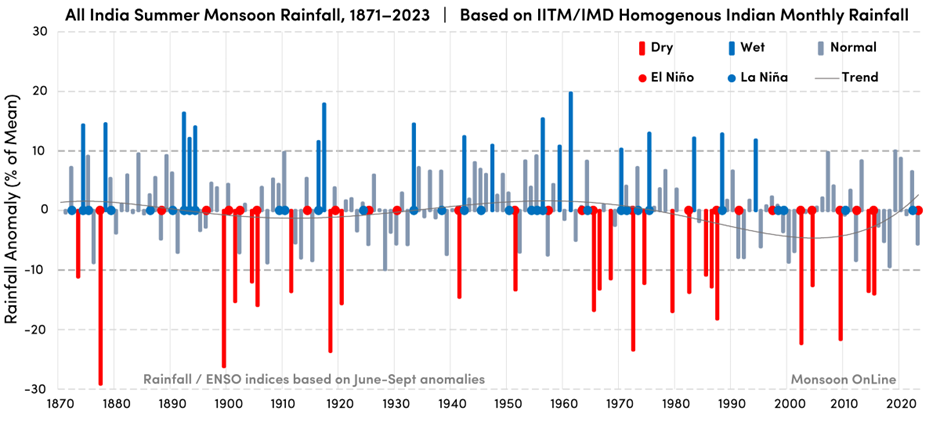
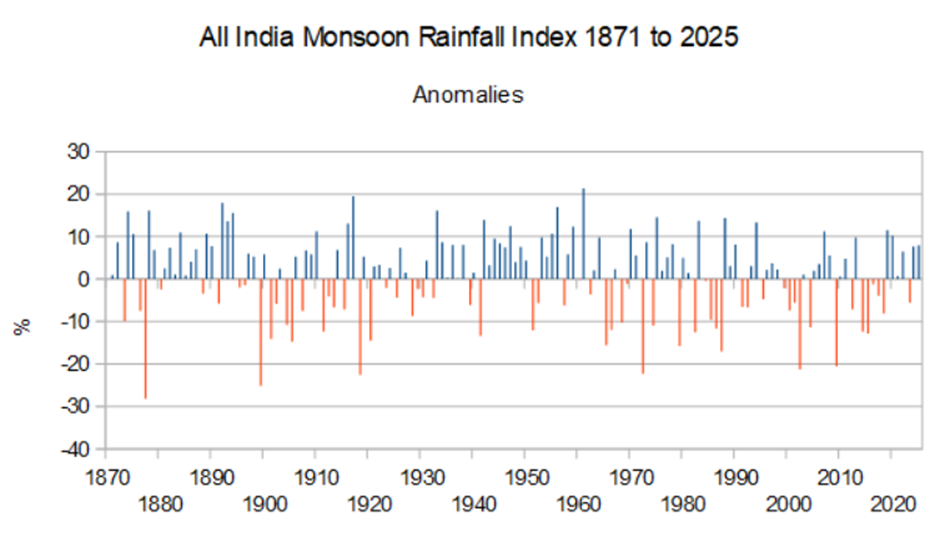
Contrary to the misinformation put out by the BBC a couple of years ago, India’s monsoons have not been drying up. On the contrary, droughts were much more severe in the 1960s to 80s when global temperatures were dropping.
The chart below from Monsoon Online runs to 2023, but I have updated it to this year in the graph below it:
Indian meteorologists generally define drought as a rainfall deficit of 10% or more; the next chart plots these drought years. Since 2010, there have only been two

Discussion
Comments
This week across the site:
To join in with the discussion please make a donation to the Daily Sceptic.
Profanity and abuse will be removed and may lead to a permanent ban.
Climate activists are using weather fluctuations in either direction. It is human arrogance to assume that our pointless little activities can change the ecosphere of the planet.
Pollution is ours, we need to own it and fix it, but the hysterical nonsense about carbon is ridiculous.
Yes exactly.
The other point is the Hunga Tonga underwater volcanic eruption of 15.01.2022 which put 13% more water vapour into the stratosphere. That which goes up will come down in good time.
There is no doubt the world is experiencing weather manipulation. No one can deny the chem trails, day after day, being spread by aircraft. Professor Willie Soon, an astrophysicist is a good resource for climate science data. Why anyone would use the bbc for anything other than stories about movie stars and royalty, is does not make sense.
Political Thinking with Nick Robinson and Claire Coutinho
18th Oct, on BBC Radio 4.The topic was Climate, Identity and Cooking.
Nick suggested that the abandonment of net zero could be seen as some sort of existential threat to humanity. Claire gave an adequate repost in the time available before the discussion turned to identity.
I didn’t listen to the rest of the broadcast as I couldn’t fathom out how the abolition of the Net Zero policy which, if pursued (according to Nick), could endanger our very existence, was given such a cursory examination. Unless, of course, it was intended to dilute Claire’s message and distract the listeners from the existential threat of the Net Zero policy.
I remember a National Geographic cover photo of an Indian tailor carrying his sewing machine while crossing a monsoon-swollen river up to his neck. That was probably some forty years ago. I suspect the BBC “researchers” can only draw upon much fewer years of experience, such that every year is “unprecedented”.
Surely nobody takes any notice of the unhinged BBC?
Water is wet yet again.
India has a population of 1.451 billion people. 1500 of 1.451 billion people dying is a non-event, regardless of the cause. That’s only 5.5% of the number of people which die in India every day.
As Professor Humlum’s scholarly analysis shows year after year…
https://thegwpf.org/content/uploads/2025/10/The-State-of-the-Climate-2024.pdf
“…Believing that one minor constituent of the atmosphere (CO₂) controls nearly all aspects of climate is amazingly naïve and entirely unrealistic.
…There is no observational evidence for any global climate crisis.
…Our world should consider focussing on much more pressing problems.”
Great reference. Thanks.
Defunding the BBC is probably the most important task for reform after they win the next election, perhaps after lunch on day 1 having stopped the boats in the morning – task anybody here could achieve in a morning. We know what they need to do.