

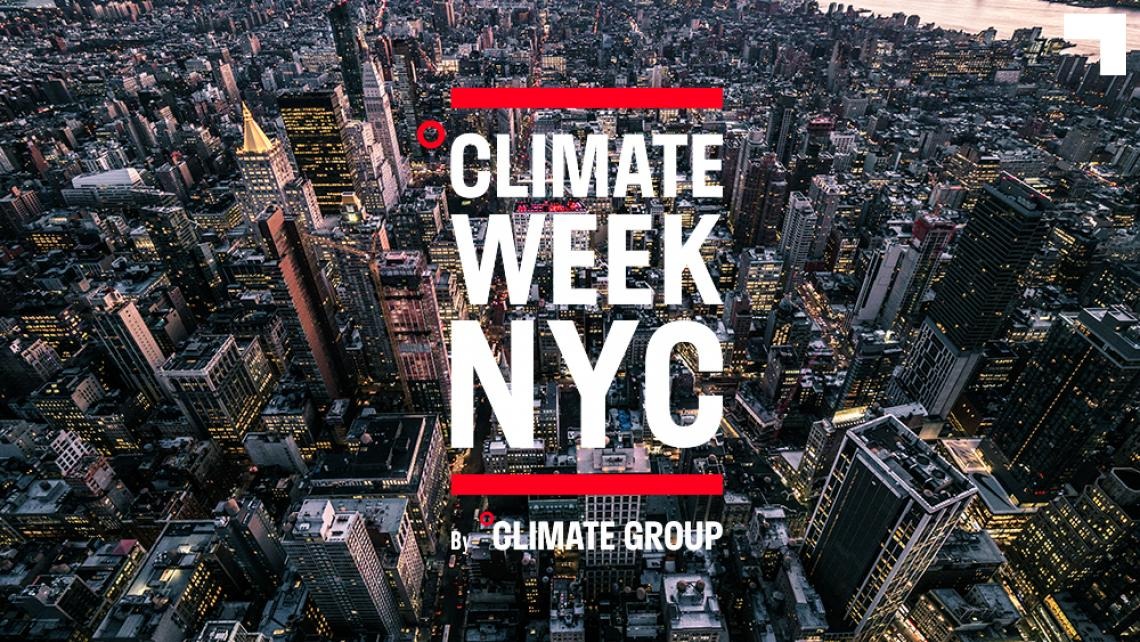
Every September the United Nations General Assembly’s high-level week coincides with what its promoters modestly call the world’s largest climate event – Climate Week NYC. The organisers insist the timing is no accident. With heads of state, ministers, bankers and the assembled apparatus of the climate-industrial complex already gathered for the General Assembly, running a parallel, thousand-event climate jamboree spares everyone a second transatlantic flight. This year the pattern held precisely to form.
The 81st UNGA’s General Debate ran from September 22nd to 26th; Secretary-General António Guterres convened his “High-Level Meeting on Climate Action and the Just Transition” in the middle of it, on September 23rd; and Climate Week NYC filled the gaps around it from September 20th to 27th. Research outfits such as Columbia University’s Center on Global Energy Policy duly received star billing in the proceedings, as I noted last year when reviewing this event’s visible decline into irrelevance.
The two events are formally distinct – the General Assembly is the UN’s own sovereign-state machinery, while Climate Week is run by a private non-profit, the Climate Group, with no UN mandate at all – but the distinction is academic. The whole point of scheduling one alongside the other is that presidents, prime ministers, central bankers and NGO grandees are already in Manhattan for the diplomatic circuit, so a parallel programme of corporate pledges, academic research institutions and philanthropic panels can be organised at minimal extra travel cost. The result, year after year, is the same choreography: a sober-sounding UN track running alongside a carnival of announcements timed for maximum media pickup, with the same cast of characters drifting between the two rooms.
The Sermon from Turtle Bay
On September 23rd, Mr Guterres delivered his now-familiar green liturgy to the General Assembly: the world, he intoned, is crying out for “climate justice”; there is, naturally, “not a moment to lose”; and renewables, he assured delegates, are “the cheapest, fastest and most secure source of new electricity almost everywhere”, with clean energy having gone “from alternative to unstoppable”. As with every liturgy, doom is swiftly followed by salvation. He reassured the UN General Assembly that “fortunately, we have a way out”. It is the standard two-step of climate rhetoric: warn of Armageddon, then offer redemption.
The trouble is that the “cheapest electricity” claim collapses the moment it is measured honestly. The levelised-cost comparisons habitually cited strip out the cost of the backup capacity, transmission and storage that intermittent wind and solar require to keep a modern grid running. These are costs that, once included, erase the supposed savings of renewables. Nor did the Secretary-General pause to mention that electricity accounts for only around one-fifth of global final energy consumption. The other four-fifths – heating, transport, heavy industry – still runs overwhelmingly on hydrocarbons.
Compare the Secretary-General’s triumphalism with the observation by US Energy Secretary Chris Wright when he said that roughly $10 trillion in cumulative global spending on wind, solar and batteries over the past two decades has still not lifted their combined share of global primary energy past about 3%. Twenty years and 10 trillion dollars for a 3% penetration level in global energy use is not “unstoppable” growth of renewable energy. It is a tiny increase at spectacular cost.
None of this stops the UN statisticians from producing ever more flattering numbers. The technical reports that accompany these annual UN set pieces routinely cite figures from the International Renewable Energy Agency. IRENA claims solar costs falling by roughly 40% and offshore wind by over 50% relative to fossil generation, and “trillions of dollars a year” now flow into “clean energy investment” worldwide. No mention is made of the fact that these “trillions of dollars” are not private sector investments made with the prospect of profits. Rather, they are made up overwhelmingly of taxpayer-financed subsidies imposed by government policies.
Energy deprivation in the Empire State
The irony is that all this UN and Climate Week NYC triumphalism is staged in a state where energy reliability is failing. New York Governor Kathy Hochul’s climate policies – gas pipeline bans, ballooning offshore-wind cost overruns and a self-inflicted capacity crunch – have made New York a case study in engineered energy scarcity. Her policies leave households and businesses paying among the highest electricity prices in the country for a supposedly cheaper fuel mix.
As Francis Menton, writing in his Manhattan Contrarian blog, has documented exhaustively, New York state’s energy policy under Governor Kathy Hochul is anything but rational. Ms Hochul’s administration continues to pass the costs of its energy fantasies on to households and businesses least able to absorb them. New Yorkers, in short, are living the counter-experiment to Mr Guterres’s UNGA sermon in real time – only a few subway stops from where he delivered it. It is important to note just how perverse this juxtaposition is. The state that hosts the world’s premier climate jamboree is simultaneously demonstrating, in its own utility bills, precisely why the premise of that jamboree is utterly false.
Berlin’s fossil-fuelled sermon and UK’s ‘Mad Ed’ joins the choir
Not to be outdone, Germany’s Federal Environment Minister Carsten Schneider travelled to New York for Climate Week and the General Assembly to unveil his country’s “roadmap for transitioning away from fossil fuels”. This is the same Germany that, having shuttered its nuclear and coal fleet on ideological grounds, now pays among the highest household electricity and gas prices in Europe. It has been leaning ever more heavily on coal-fired power to keep its lights on. A German minister telling the UN that the world should leave fossil fuels, while his own system still leans on lignite, hard coal and gas every time the wind drops, is not merely ironic. It is the defining genre of this entire New York season – grand declarations issued in Manhattan, detached from the burden of electricity bills paid by working households.
Great Britain, of course, is on the same track as deindustrialising Germany. Ed Miliband – for four years the face of the UK’s own Net Zero crusade as Energy Secretary, and now, following a summer reshuffle, Foreign Secretary – addressed New York Climate Week’s opening ceremony on September 21st. He struck the now-mandatory note of triumphalism, boasting that 2026 would see $2.2 trillion flow into clean energy worldwide against $1.2 trillion into fossil fuels. He said that “I think that deserves a round of applause.”
Money spent on intermittent, weather-dependent renewables is not the same as actual energy delivered in kilowatt hours and undoes Mr Guterres’s arithmetic. Jaime Jessop has thoroughly dissected the Guardian‘s credulous amplification of Mr Miliband’s numbers. The Net Zero enthusiasms of “Mad Ed” have coincided with the UK recording the highest industrial electricity prices in the developed world – 27% above Germany’s, and a multiple of America’s and China’s. Whitehall’s energy policy is not merely in the same fantasy land as Berlin’s; on the actual electricity bill, it is worse.
Money that does not exist
On climate finance, Mr Guterres called on developed countries to mobilise at least $300 billion a year for developing nations, rising to $1,300 billion a year by 2035. These figures are not new – they are the headline outputs of the New Collective Quantified Goal thrashed out at COP29 in Baku, later dressed up as the Baku to Belém Roadmap ahead of COP30 – but reciting them again at the UNGA does nothing to make them real. The unreality is glaring. The EU is running historic deficits, several member states are flirting with fiscal crisis and European governments are simultaneously being pressed to fund ever-larger military budgets in their campaign against Russia. And the UN chief Guterres himself has warned that the world body faces “imminent financial collapse” due to non-payment of dues by member nations.
Conjuring another trillion-plus dollars a year for “climate finance” out of treasuries that cannot balance their own books is merely wishful accounting. Developing countries were promised similarly grand sums before, most notably the still-unmet $100 billion pledge dating back to 2009. Every year the target grows larger and the political and fiscal capacity to meet it shrinks further. That gap between rhetoric and treasury encapsulates the entire story of the UN’s climate diplomacy since the UN Copenhagen climate summit in 2009.
The New York City setting of the September climate jamborees reveals the farce. This is a city carrying colossal municipal debt, some of the country’s heaviest taxation, an acute affordability and housing crisis and rising rents. It is now governed by socialist Mayor Zohran Mamdani. He took office on January 1st 2026 pledging to entrench the city’s sanctuary-city status and pursue rent freezes for the roughly two million New Yorkers living in rent-stabilised apartments. Add to that a surge in concern over antisemitism, strained public services, collapsing institutional trust and a political class seemingly convinced that weather-dependent wind, solar and batteries can run a modern metropolis, and one has the full backdrop against which the visiting dignitaries assure each other that the “just transition” and “climate justice” march on. The gap between what the elites gathered at Turtle Bay believe about energy and how ordinary city residents actually live is, for some reason, not evident to the luminaries assembled at the September climate fest.
The road to nowhere, via Ankara
This year’s proceedings are also a warm-up act for COP31, due to be held in Turkey. Readers who followed my assessments of previous UN climate summits (here and here) will recognise the pattern: grand communiqués, promises of “energy transition” and no discernible dent in the world’s actual fuel mix and carbon emissions. The developing world is, in fact, moving in precisely the opposite direction from the one prescribed in Manhattan. China and India – together home to nearly three billion people – are doubling down on coal-fired power generation, partly as insurance against the energy-security shock triggered by the Strait of Hormuz blockade earlier this year.
The most sober forecasting available is the recently published S&P Global’s Multidimensional Global Energy Pathways report, authored with the Institute of Energy Economics, Japan, with a foreword by Daniel Yergin. It offers an analytically robust view of where fossil fuels are headed through 2060 without preaching the green narrative. Fossil fuels remain dominant and are still growing in absolute terms across large parts of Asia, whatever the UNGA choir may sing about “unstoppable” transitions. There is little reason to expect that COP31 in Turkey will produce anything different from COP28, COP29 or COP30 before it: another communiqué, another finance pledge, another round of applause for phrases such as “accelerate climate action” and “just transition” – whose vacuousness is obvious to any sceptical reader on first inspection – and another year in which the world’s actual energy mix moves only marginally, if at all, in the direction the UN insists is inevitable.
The circus moves on
What New York hosts every September is not serious, fact-based analysis or credible environmental and economic argument. It is a travelling circus that returns, on schedule, to a city groaning under precisely the kind of self-inflicted energy costs its visiting luminaries insist are cheap.
The largest energy consumers in Asia – China, India, Indonesia and Vietnam – are choosing coal over green communiqués. They understand energy security and the wellbeing of their citizens, unlike the assembled dignitaries and their academic advisors gathered in New York City this week. Energy reality does not bend to a General Assembly speech, however loudly it is applauded. Reliable, affordable energy is not a rhetorical achievement to be announced from a podium; it is an engineering and economic problem that has to be solved on the ground, one grid, one household bill and one industrial customer at a time.
Until the annual September pageant in New York grapples realistically with energy policy, the gap between the green liturgy and affordable, secure energy supply will keep widening. The clown show, sadly, will be back again next September in New York City.
Dr Tilak K. Doshi is the Daily Sceptic‘s Energy Editor. He is an economist, a member of the CO₂ Coalition and a former contributor to Forbes. Follow him on Substack and X.




Discussion
Comments
This week across the site:
To join in with the discussion please make a donation to the Daily Sceptic.
Profanity and abuse will be removed and may lead to a permanent ban.