

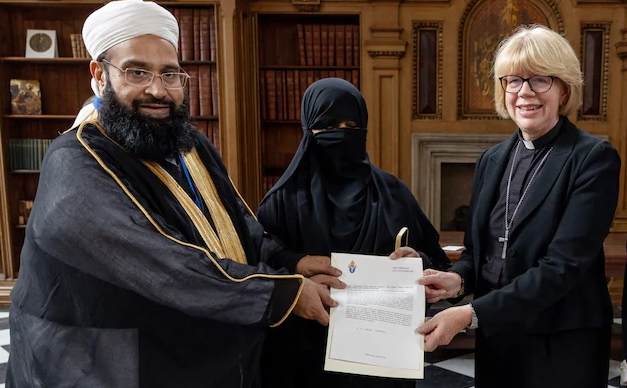
Sydney Sweeney’s bare beauty, seven-year-old girls in compulsory headscarves, the entirely black-clad wife of an Pakistani cleric honoured by the Archbishop of Canterbury and the Labour prospective Parliamentary candidate for Camden’s Somalian attire have all animated the national conversation in recent days. While such garments, or lack of, are being used to illustrate civilisational social chasms, I wonder if in fact they represent instead Freud’s narcissism of small differences. Such powerful visual incidents are leading some to shout louder the spine-chilling online mantra: millions must go, when, in actuality, the reimagining of sumptuary laws might be all that’s needed to dissolve superficial differences between people who share more in common than their clothes would immediately suggest.
As Miuccia Prada says: “Fashion is instant language.” Clothing offers the immediate social legibility: where you’re from, your class, your education, your aspirations. Where I live in Hampshire it is easy to spot the richest of landowners by the inexecrable nature of their ancient wax jackets (this applies to men and women). I am ethnically more German than English, yet I shop at Mole Valley and Vinted like everyone else in the village. If I wore a dirndl and my hair like Helga in ‘Allo ‘Allo! I suspect I might have raised a suspicious eyebrow amongst our neighbours.
Similarly, the seamless manner in which the 500,000 people of Chinese heritage have settled in Britain is as much to do with their quiet business-like contribution to communities as the fact they don’t, as a rule, wear Manchurian clothing or style hair into queues. The same applies to Poles, Ukrainians, Hong Kongers and so on who have made their homes in Britain in recent decades.
Inclusion and social cohesion is much less about ethnicity or skin colour than how we choose to present ourselves. Zia Yusuf would not be nearly so popular with GB News viewers if he dressed like Mothin Ali. I remember running a public speaking workshop for young women in Gosport who were all wearing the same uniform of the teenage girl a couple of years ago: baggy jeans, crop tops and North Face puffas. On getting to know them I discovered they hailed from Poland, Hungary, Latvia, Bangladesh and Gosport. As all teenage girls, they had found friendship and social safety in dressing alike in a narrow variety of the same outfit. (Same goes for centrist Dads in their quarter zips, political wonks in their slender navy suits and ambitious tradesmen in fake/real Moncler.)
And yet, I admit that seeing primary aged girls in headscarves saddens me, as does a track-suited man with his niqab wearing wife. It’s lazy to accuse me of bigotry or fear – it’s not actually that deep. I have no doubt that Sagal Abdi-Wali has more in common with me than she would a nomadic woman from Somalia who shares the same taste in head-dresses. Our shared cultural frame of reference, day to day life, and education bind us together in ways our clothes appear to radically clash.
If the difference between us is in fact merely superficial, should we therefore resurrect the sumptuary laws and ban religious clothing entirely from publicly-funded institutions and naked exposure from the public square? As Virgina Woolf explains: “Vain trifles as they seem, clothes have, they say, more important offices than to merely keep us warm. They change our view of the world and the world’s view of us.”
After the population collapse occasioned by the Black Death in 1348, peasants were famously able to demand higher wages and began wearing fancier clothes. The powers that be didn’t like this disintegration of social signifiers so Edward III introduced A Statute Concerning Diet and Apparel in 1363. Yeoman were forbidden from wearing silk and squires from wearing ermine. In 1574 Elizabeth I was furious about the amount of money young men were wasting on fripperies so issued a Statutes of Apparel in Greenwich, stating:
The excess of apparel and the superfluity of unnecessary foreign wares thereto belonging now of late years is grown by sufferance to such an extremity that the manifest decay of the whole realm generally is like to follow. … None shall wear in his apparel: any silk of the colour of purple, cloth of gold tissued, nor fur of sables.
Other countries have embraced sumptuary laws in efforts to nation-build. Peter the Great established a beard tax in 1698 in order to direct the country westward and secularising Ataturk famously outlawed the fez in newly formed Turkey in 1925. Various countries in Europe are trying to ban the burka and Le Pen has promised a referendum on headscarves.
However, English sumptuary laws failed miserably. Enforcement was sporadic, deeply unpopular and generally ineffective. The official sumptuary laws were repealed by James I in 1604 and coincided with the growth of the merchant and later middle classes. An ability to move freely through social groupings is vital to the prosperity of a nation. Free dress equals freedom of thought equals free trade. As a general rule, outlawing an item of clothing only ever strengthens the desire to wear it. The Dress Act of 1746 entirely failed in its attempt to ban tartan and highland dress.
Boris Johnson spoke into this tradition of fashion freedom when he defended women’s right to dress as letterboxes if they so wished. Sumptuary laws didn’t work in England in the 14th century and won’t work now. Instead we have to hope that British designers and influencers create clothes so beautiful everyone, from whatever historic background, will want to wear them.
Joanna Gray is a writer and confidence coach.


Discussion
Comments
This week across the site:
To join in with the discussion please make a donation to the Daily Sceptic.
Profanity and abuse will be removed and may lead to a permanent ban.
“Clothing offers the immediate social legibility: where you’re from, your class, your education, your aspirations.”
Exactly, so if you dress like a Pakistani man or woman I quite rightly conclude that the wearer is from a Turd World shithole and follows a barbaric, heathen cult which has no place whatsoever in my homeland; and the message the clothes convey is that we have nothing, absolutely nothing in common. Furthermore, native dress sends a two-fingered salute to the honest, decent Brits and my attitude in response is – sod off back to where you belong because I certainly don’t want you and your 7th century ways.
How can Joanna seriously claim that there’s only superficial differences between civilized people of European heritage and the barbaric hordes that practice, or at the very least don’t condemn, female genital mutilation, honour based violence, suicide attacks etc. etc?
We already have sumptuary law – Net Zero.
The excess of apparel of man-made fibres, the superfluity of unnecessary foreign travel or local travel, home comforts, warm homes, cheap and reliable energy, inexpensive cars that travel long distances, eating of meat, any consumption that gives us pleasure but offends the gods of climate.
“Instead we have to hope that British designers and influencers create clothes so beautiful everyone, from whatever historic background, will want to wear them.”
Optimistic.
I suspect those who wear the full bin bag don’t get much choice in the matter
An interesting piece, but think the conclusion nails it – any clothing law would be unenforceable and unenforced. We have enough of those laws already, including legislation on more important areas like road safety, drug use, immigration.
“the spine-chilling online mantra: millions must go“
So do we assume the author is quite content with millions of illegals invading our country, and millions more of foreigners with zero intention of assimilating, all squatting here, turning inner cities into third world slums, driving up housing prices as natives are displaced, and pushing the welfare bill through the roof?
But don’t worry, if they wear normal clothes they might stop abusing women and children and animals, and suddenly gain a sense of moral behavior?! Sure….
Andy can send anyone who abuses a woman an email telling then to stop. The reward would be a council flat, Pension aka benefit for life and exemption from military service due to the fact that our head of state is a Christian.
Excellent post!
The woman is an absolute imbecile, how did she get appointed to her role? oh I know, it was our monarch who appointed her. Defender of the faith, the man who people would be expected to die for in the event of the imminent war. Ask Jacob Rees-Mogg, even he thinks it’s a good idea to die against an enemy that only exists in the minds of the equally deranged establishment. How the F… did we come to this!
I think the King believes himself defender of ‘faith’ as an abstract noun, rather than THE faith.
Yes, it was nauseating to watch that video Rees-Mogg put out, lecturing the nation’s men that it is “your duty” to be conscripted to defend the country from Russia, and “some of you will die”.
Notice he didn’t say “some of us”, or “some of my own six children” will die.
He meant “Some of you Proles will die”. 🙄
Dear Rees-Mogg,
You’re an arrogant git.
Yours sincerely,
The Proles
“Some of you may die, but it’s a sacrifice I am willing to make,”
😄
Lieutenant Louis Leyson Rees-Mogg (1890–1915): His relative from the Somerset branch who served with the Royal Engineers and died during World War I.
And?
Off topic but that cleric also refused to shake the AoC’s hand because she is a woman. I’d have turned round and walked off taking the award with me but then I’m not an appeaser like she is.
Or she should have said to her assistant,
“We must remember the Scripture about Jesus driving the merchants out of the Temple. Bring me my clerical whip!”
🙂