

Whilst the villagers of Piddington dominated the headline with their homage to the Ealing comedy Passport to Pimlico, there was another slice of nostalgia to be found occurring some 50 miles south in Brighton at the TUC’s 158th annual conference in Brighton.
The TUC was at its zenith in the 70s and 80s with membership of trades unions peaking in 1980 at 12.2 million. For those with long memories, Vic Feather, Len Murray and Norman Willis (all ennobled) presiding as general secretaries was an enervating time. Many today are unaware of the vice like grip unions held and the real damage that they could cause. ‘Red Robbo’ at British Leyland was but one of the well-known unions faces forever in the news, justifying inflicting another bout of inconvenience on the public. ASLEF, the RMT, NUPE, NUM, TSSA, USDAW, it was a bewildering alphabet soup of militancy, nowhere more so that in Fleet Street.
Here, NATSOPA – (memorably parodied in Private Eye as notsober), the NGA and SOGAT would walk out or down tools at the first opportunity. Inter union disputes were commonplace and the union leaders’ realisation that a commodity with a shelf life of one day was ripe for exploitation saw newspaper proprietors all too easily bend to their increasingly unhinged demands.
Murdoch, and to a great degree Eddie Shah, paved the way for emasculating and ultimately destroying their power base. Those who experienced the ‘Battle of Wapping’ would perhaps never forget what raw unbridled industrial muscle meant – similarly those who witnessed the Battle of Orgreave.
Margaret Thatcher’s legislation went some way to restricting the relative ease with which unions could go on strike. While the world has changed in multiple ways, and the workplace and workforce are unrecognisable landscapes from 40 years ago, it is heartening to see that the TUC today, like chloroformed butterflies pinned in a glass display case, is forever preserved in its own time capsule.
While Barbara Cartland’s England was a land with pretty virgins and unscrupulous cads, the TUC today inhabits a Victorian world teeming with exploited workers, rapacious bosses and a forever simmering cauldron of victimhood and grievance.
With TUC membership now halved at around 6.5 million, AI destroying jobs at breakneck speed, job losses mounting across hospitality, retail, steel, gambling and tourism (to name but a few), one would assume that the TUC would be on the front foot, evolving and mutating to this shifting and dynamic environment.
But in the lanyard-wearing world of trade unionism, and more pertinently in the realm of public sector workers, life is very much mired in the 80s: a land of comrades and work, a relentless struggle against oppression.
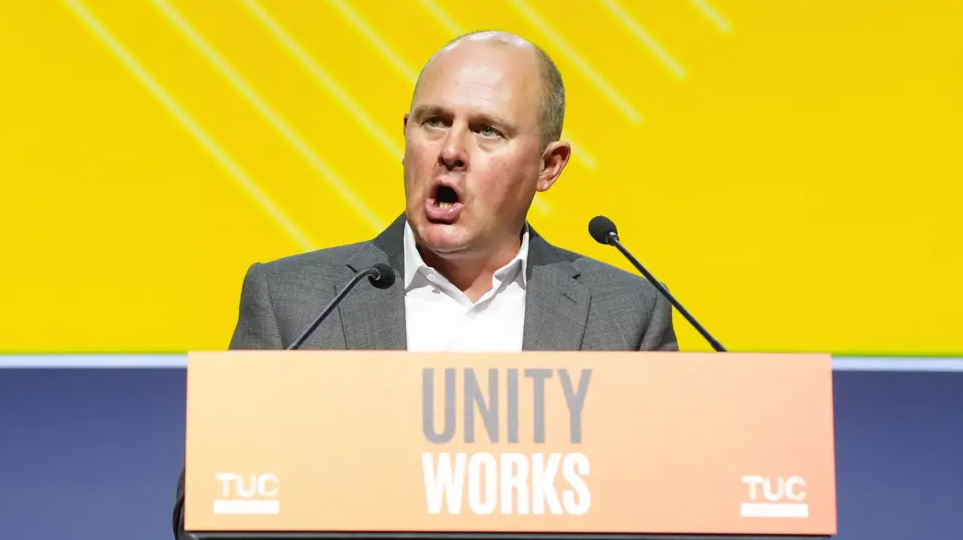
Here is TUC General Secretary Paul Nowak’s opening address, under the predictable backdrop emblazoned with the fatuous slogan “Unity Works”.
Two months ago, I met Dorian, Said, Mohammed and their colleagues at Chase Farm – an NHS hospital. Outsourced workers delivering vital public services. And I’ve stood alongside countless workers like them in so many other unions. Feeding patients. Protecting the public. Cleaning our trains. And everywhere, everywhere the same raw deal. Bounced from one private company to another. Insecure contracts. No proper sick pay. Bare minimum pensions.
Warming to his Dickensian theme he carried on warning that:
We won’t stand by while the chief executives and shareholders of the outsourcing giants rake it in at the expense of workers, service users and taxpayers.
Quite naturally there had to be a dig at successful entrepreneurs creating thousands of jobs;
If union busting tech billionaires can blast their pop star mates into space, then they can pay more tax.
Jeff Bezos – we are coming for you and every other bad boss.
And so say all of us. All that was missing was a call to stop urchins being sent up chimneys in toffs’ mansions.
No wonder the UK is in the state it’s in with a mindset mired in the past.
No vision, no aspiration and an attitude rooted in envy and class division.
Bogeyman Farage came in for predictable opprobrium:
The man who sips champagne and eats oysters while taking dodgy donations from foreign funders.
For scholars of Dave Spart, here is a small selection from the lengthy list of motions that illustrate perfectly just how captured and out of touch the TUC is.
- C05: Countering far Right attacks and defending education;
- Motion 12: Addressing the rising influence of far Right parties;
- Motion 13: Tackling the far Right and the weaponisation of women’s and girls safety;
- Motion 03; Family friendly rights;
- Motion 30: Defend regulators, oppose deregulation;
- Motion 34 Public Sector Pay;
- C14 Climate Heat Emergency;
- C15 Protecting Public Service Broadcasting;
- Motion 76: End the siege of Cuba;
- And of course a plethora of motions concerning Palestine.
Looking at the confusing and diverse range of concerns the TUC has you realise what a malign and backward-looking outfit it really is. Devoid of common sense and fighting endless quixotic battles with imaginary long slain foes, one would like to think it was an inconsequential vanity project of little importance.
The depressing truth I think, though, is that it is sadly a mirror of our broken and unhappy society, where stoking discord and division is now part of the fabric. The interests and views espoused in Brighton clearly confirm that, notwithstanding all the talk of ‘unity is strength’ and so on, Britain is really teetering on the brink of financial and societal rupture.
As we swirl uncontrollably in a vortex of our own making, spinning towards the plughole of irrelevance, one can only pose the question: have we gone beyond the point of no return?
Alexander McKibbin is a retired media executive who worked across domestic and international media.



Discussion
Comments
This week across the site:
To join in with the discussion please make a donation to the Daily Sceptic.
Profanity and abuse will be removed and may lead to a permanent ban.
Labour’s post-war nationalisation meant “the workers owned the means of production”, and the irony was those strikes were not against rich, capitalist, b’tards, but themselves.
They operate “closed shop” arrangements with management. Only a union member of the appropriate union for the job could be employed – demarcation. This meant chronic overstaffing. If a water heater had to be fitted, unlike today where one person can do it, then a plumber had to do the pipework, a maintenance man had to drill holes in the wall, fix the heater to the wall, then an electrician had to come and connect it to the electricity. If a plumber dared change a fuse in a plug – “Everybody out!”
What closed shop also meant was immigrant workers who undercut wages could be excluded from companies by unions refusing them membership. This was (of course) racism! because most immigrants were non-white, but actually it had nothing to do with race. It did however give the Government the excuse to pass the 1963 Race Relations Act which specifically forbade discrimination in the work place, forbade unions for denying membership based on race.
The Government wasn’t trying to protect minorities, it was… Read more »
Bring on the “far right” fighting for british workers and british people.