


Metropolitan Cathedral of the Most Precious Blood, informally known as Westminster Cathedral, is the largest Catholic church in England and Wales. It is dedicated to the Blood of Jesus Christ and is the seat of the Archbishop of Westminster.
There are times when the argument for Western civilisation does not require another book, another political speech or another furious exchange on social media; sometimes two minutes and twenty-three seconds of music can make the case rather better.
This is Giovanni Pierluigi da Palestrina’s Exsultate Deo, sung by Westminster Cathedral Choir under Stephen Cleobury in 1982.
I have listened to many recordings of this piece over the years, including performances which are technically immaculate, but this remains my favourite. There is something about the Westminster Cathedral recording which seems to gather together several different strands of the European inheritance and make them momentarily audible as one thing; Hebrew poetry, Roman Christianity, Renaissance Italy, the ancient plainsong tradition of the Western Church and the peculiar genius of the English choral tradition all meet in a recording made in a Catholic cathedral in London by a choir whose history itself reaches backwards through the great cultural rupture of the English Reformation.
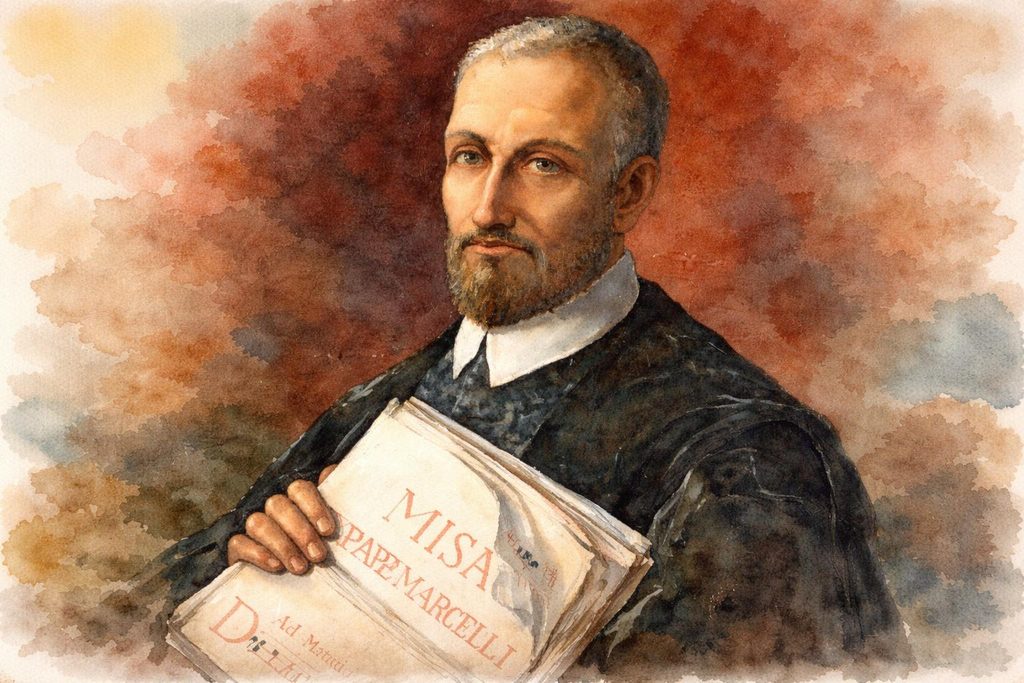
Palestrina was born Giovanni Pierluigi, probably in the 1520s, in the town of Palestrina near Rome, from which we derive the name by which he is now universally known. He lived through one of the great convulsions in European religious history – the Reformation and Catholic Reformation – and became perhaps the composer most closely associated with the musical culture of 16th-century Rome. He served at some of the greatest churches of the city, including St Peter’s, St John Lateran and Santa Maria Maggiore, and his enormous body of sacred music became one of the defining expressions of Renaissance Catholicism.
Exsultate Deo was published in 1584 in Palestrina’s fifth book of motets and is written for five voices. Its words come from Psalm 80 in the Vulgate numbering, Psalm 81 in most modern Bibles:
Exsultate Deo adiutori nostro; jubilate Deo Jacob. Sumite psalmum et date tympanum; psalterium jucundum cum cithara. Buccinate in neomenia tuba, insigni die solemnitatis vestrae.
Rejoice in God our helper; sing aloud to the God of Jacob. Take up the psalm and sound the timbrel; the pleasant psaltery with the harp. Blow the trumpet at the new moon, on the appointed day of your solemn feast.
That history is worth contemplating for a moment because it tells us something about what Western civilisation actually is. The words were already ancient when Christianity began; they emerged from the religious culture of Israel, were translated into Greek and Latin, became part of the prayer of the Christian Church, were sung for centuries in monasteries and churches across Europe and were then taken by an Italian Renaissance composer and transformed into polyphony of astonishing sophistication and beauty. Four centuries later that music was being sung in London by English boys and men inside a cathedral finally completed in 1906 by a Catholic community which had itself survived centuries of persecution, suppression and exclusion. Civilisation is cumulative in precisely this sense: each generation receives things which it did not create and could not recreate by itself, preserving some of them, changing others, and handing them onwards.
We have become strangely accustomed to talking about Western civilisation principally through its failures, as though the civilisation which produced the modern Western world were essentially an indictment awaiting prosecution. There are failures enough, certainly; human beings are involved, and therefore there always will be. Yet this relentless excavation of guilt has produced a peculiar inability to recognise inheritance, and the things we inherit include languages, institutions, law, music, architecture, literature, philosophy, customs and moral assumptions which are the accumulated product of people separated from us by centuries, most of whose names we will never know.
A cathedral choir is a particularly wonderful example because it cannot really be invented overnight. Westminster Cathedral Choir was founded at the beginning of the 20th Century, but the tradition upon which it drew was vastly older. Its first Master of Music, Sir Richard Terry, devoted himself to recovering the neglected music of the English Renaissance, bringing composers such as Tallis, Byrd and Sheppard back into the living liturgical tradition alongside Gregorian chant and the continental polyphonists. George Malcolm subsequently developed the extraordinary, brilliant Westminster sound of the boys’ voices; later came Colin Mawby, Stephen Cleobury, David Hill, James O’Donnell and others. The choir exists because knowledge is transmitted: one generation teaches another how to breathe, how to phrase, how to pronounce, how to listen, how to stand, how to read music, how to shape a line and, above all, how to subordinate the individual voice sufficiently that something greater can emerge from all of them.
That principle becomes audible from the beginning of the recording. Exsultate Deo adiutori nostro. The individual voices are perfectly distinguishable and yet none is attempting to dominate; Palestrina constructs the music through their relationship with one another, as a phrase appears in one part and is answered elsewhere and the musical argument moves between the voices until something exists which could not possibly be produced by any one of them alone. Its richness depends upon difference, discipline, relationship and order, and there is an entire theory of civilisation contained within it if we are prepared to listen.
The 1982 recording is particularly interesting because Stephen Cleobury occupied an unusual position in the history of Westminster Cathedral Choir. He was the first Anglican to become its Master of Music and had been formed within the great English collegiate choral tradition. Westminster itself possessed another inheritance, developed particularly under George Malcolm, whose more brilliant and forceful continental sound had deliberately distinguished the Cathedral from the restrained style associated with many Anglican foundations. Under Cleobury those traditions met, and the result is audible in the extraordinary attention given to the words. The consonants have weight and the Latin is never allowed simply to dissolve into a beautiful cloud of sound. Exsultate. Rejoice. Jubilate. Sing aloud. Buccinate. Blow the trumpet. The music is beautiful, certainly, but it is proclaiming something, and Cleobury allows the text to propel the music forwards; at buccinate in neomenia tuba the voices almost become the trumpet of the Psalm itself.
This is one of the characteristics I love about the English choral tradition, with its insistence that sacred music contains words and that the words mean something; diction matters because meaning matters. The continental tradition, including that associated with the great Roman and papal choirs, has often produced a different sound – smoother in its lines and less aggressive in its consonants – allowing voices to merge into an almost architectural body of sound in which the polyphony can seem to float above the listener and the individual human voices disappear into something larger and almost incorporeal. It can be extraordinarily beautiful. Westminster has a different quality; there is light in it, but also bone, and perhaps that is why this particular recording has stayed with me for so long.
There is another historical irony here. Much of what we now think of as the English cathedral choral tradition had to be recovered and rebuilt. The religious upheavals of the 16th and 17th centuries shattered an enormous amount of musical continuity; medieval English Catholicism had possessed an extraordinarily sophisticated musical culture, and the Reformation destroyed institutions, dispersed libraries, ended foundations and rendered vast quantities of sacred music unusable. Yet fragments survived, manuscripts survived and traditions survived in altered form. The Anglican choral foundations preserved and subsequently developed elements of the older English inheritance, while the Catholic revival of the 19th Century and the foundation of Westminster Cathedral created the circumstances in which Catholic England could begin consciously recovering what had been lost.
By 1982, therefore, we arrive at something rather wonderful: Palestrina, the supreme composer of the Roman Catholic Renaissance, being sung in Westminster Cathedral by a Catholic choir under an Anglican Master of Music, using musical disciplines shaped by traditions which had spent centuries developing separately after having originated in the same medieval Christian civilisation. There is something of Western civilisation itself in that convergence – an inheritance formed through Greek philosophy and Roman law, Jerusalem and Athens, Christianity and classical learning, medieval monasteries and Renaissance workshops, universities and parliaments, painters, masons, philosophers, scientists and composers; it has been accumulated over centuries by innumerable men and women who received things from those who came before them, added something of their own and handed them onwards because they understood that inheritance carries obligations as well as benefits.
Preservation has never required cultural embalming. Palestrina was himself an innovator working within an inherited tradition; Terry recovered forgotten music, Malcolm changed the sound of Westminster Cathedral Choir and Cleobury brought another musical inheritance into it. Tradition survives because each generation receives something, inhabits it and then passes it onwards, while the failure of that process produces cultural amnesia rather than liberation from the past.
That is what worries me about our present moment. We have become exceptionally good at teaching people how to interrogate their inheritance and remarkably bad at teaching them how to love it. Children can leave education knowing a great deal about the sins committed by Western societies while knowing almost nothing about the civilisation in which those sins were recognised as sins; they can discuss empire without knowing Augustine, inequality without knowing Aquinas, patriarchy without knowing Dante, power without knowing Shakespeare, religious conflict without knowing Bach, Byrd or Palestrina. We are producing generations equipped with a prosecutor’s brief against their ancestors but increasingly unable to recognise what their ancestors actually gave them.
It is worth listening again to those two minutes and twenty-three seconds and considering what had to happen for that recording to exist. An ancient people had to compose the Psalm; Christianity had to carry it into Europe; Latin had to become the common language of the Western Church; musical notation had to develop sufficiently for increasingly complex compositions to be preserved; monastic and cathedral institutions had to sustain generations of professional musicians; Renaissance Italy had to possess the prosperity, education and religious culture capable of supporting a man like Palestrina, and his music then had to survive the centuries which followed. The English choral tradition had to survive Reformation, civil war, religious persecution, industrialisation and two world wars; English Catholicism had to emerge from the catacombs and build Westminster Cathedral; Cardinal Vaughan had to decide that his new cathedral required a great choir; Richard Terry had to recover forgotten Renaissance music; George Malcolm had to reinvent the sound of that choir; a succession of teachers had to train generation after generation of boys, parents had to entrust their children to the discipline of a choir school, and musicians had to devote their lives to mastering a craft which cannot be learned in an afternoon. Eventually, on June 25th 1982, some microphones were placed inside Westminster Cathedral, Cleobury raised his hands, the choir breathed and the ancient words sounded again: Exsultate Deo. Rejoice in God.
I think Westminster Cathedral Choir is the finest ecclesiastical choir in the world. That is obviously a personal judgement and there are magnificent rivals, but I return to Westminster because there is something in its sound which seems to contain the civilisation that produced it: Roman and English, Catholic and shaped through encounter with Anglican England, ancient and modern, disciplined without becoming sterile, beautiful without becoming merely decorative.
We hear a great deal today about saving Western civilisation, usually in political terms, and politics certainly matters because institutions and laws matter; civilisation, however, exists considerably deeper than politics and cannot be preserved merely by winning elections. Its survival depends upon remembering it, teaching it, maintaining it and refusing to be embarrassed by its achievements; upon saving libraries and churches, teaching children old poems, reading books whose authors have been dead for five hundred years, maintaining rituals whose origins we may no longer entirely understand, preserving beautiful buildings even when a cheaper concrete one would perform the same practical function, teaching Latin, Greek, music and history and continuing to sing Palestrina. Every civilisation eventually entrusts its inheritance to another generation, and its future depends upon whether that generation considers what it has received worth the trouble of understanding, preserving and handing onwards. When I listen to Exsultate Deo, and particularly to this extraordinary recording made at Westminster more than 40 years ago, my answer is very simple: I do.
C.J. Strachan is the pseudonym of a concerned Scot who worked for 30 years as a Human Resources executive in some of the UK’s leading organisations. Subscribe to his Substack page.



Discussion
Comments
This week across the site:
To join in with the discussion please make a donation to the Daily Sceptic.
Profanity and abuse will be removed and may lead to a permanent ban.
“There is something of Western civilisation itself in that convergence – an inheritance formed through Greek philosophy and Roman law, Jerusalem and Athens, Christianity and classical learning, medieval monasteries and Renaissance workshops…The words were already ancient when Christianity began; they emerged from the religious culture of Israel, were translated into Greek and Latin, became part of the prayer of the Christian Church, were sung for centuries in monasteries and churches across Europe..”
An endless Ode to the only Christianity the Catholic Christianity that cancels totally all other Churches. Like the authentic Christianity of Emperor Constantine the Great, the founder of the Eastern Church, aka the Byzantine Empire, which lasted 1,123 years, from 330 AD until the fall of Constantinople in 1463, facilitated by the Pope’s looting army, allowing the take over of Eastern Europe by the Ottoman hordes, leaving behind the seeds of Islam in Albania and Bosnia.
For 300 years before the Fall, following Papal orders, the Venetian pirates were looting mercilessly the seas and the cities of the Byzantine Empire, destroying ancient temples and replacing them with third-rate-architecture churches.
Around that time, c.1478, and at the other end of Europe, the Spanish Inquisition continued the Catholic principle of… Read more »
Thank you for this superb essay. It really touched several chords: spiritual, musical, historical and literary.
Vatican Jesuit Propaganda.
Instructive to read the comments and note the up and down votes, which I suspect reflect the dominance of certain traditions.
It is noteworthy how the musical background inherited by the early church became suppressed: professing to be wise, etc. What was an anointed gift within the early church became fossilised into the Gregorian chants. Asses’ heads and doves’ dung, perhaps.
Not only did the Reformation restore singing to the churches, but led also (in time) to great non-conformist hymns – e.g. the works of Charles Wesley and Isaac Watts – as well as great musical compositions dedicated to the glory of God (JS Bach so used to annotate his scores).
While there was a flourishing of contemporary Christian worship music, I fear that it is now succumbing to man/self-centred lyrics, performative, commercial forms that have lost sight of the transcendence of the Almighty.
Hear, hear! And you are absolutely right to point out the “man/self-centred lyrics”, which focus on worship as a kind of ecstatic emotion raised by the huge crowds at a performance, which later evaporates when the Christian goes home alone. Some of the lyrics are even blasphemous, disgusting “Jesus is my boyfriend” sexual perversions, with silly women posing as “His Bride”, inspired by Satan.
People don’t have to enjoy listening to choral music, or agree with why it’s being sung, to realise it’s part of our cultural heritage and therefore worth preserving. The same principle applies other aspects of our culture, e.g. it’s incredibly hard to see my life would become any less enriched and meaningful if Westminster Cathedral was bulldozed and the space it occupies used for social housing for homeless veterans. However I realise this would be cultural vandalism and should never be done.
The same applies to aspects of other cultures, e.g. in terms of architecture the Blue Mosque in Istanbul is as magnificent as any European cathedral regardless of what people think about Islam and should be preserved for this reason.
It started off as a Christian church, from 360AD to 1453AD.
I am pretty sure that Palestrina and Charles Wesley have sung together in the heavenly choir!
I’m pretty sure that William Tyndale and all the other Protestant Martyrs like the Martyrs of Lewes will be singing with John and Charles Wesley in the heavenly choir. Palestrina will be enjoying time in the hot place for breaking the First & Second Commandments and refusing to repent.
It is worth listening again to those two minutes and twenty-three seconds and considering what had to happen for that recording to exist …. Eventually, on June 25th 1982, some microphones were placed inside Westminster Cathedral
All very interesting, but where did the microphones come from? Maybe the 20th century could get a mention.
Interesting article, though I’m not sure why it’s on the D Sceptic. More like something from the Spectator. CJS is nevertheless always worth reading and we can’t expect to share the same lines of reasoning all the time. The following lines cannot be allowed to pass without comment
“a cathedral finally completed in 1906 by a Catholic community which had itself survived centuries of persecution, suppression and exclusion”
Talk about the pot calling the kettle black.
Good point! How many people realize that the US citizens’ right to bear arms, enshrined in the American Constitution, is based upon the 1689 English Bill of Rights, which gave PROTESTANTS the right to bear arms for self-defence for their own protection, after the Armed Catholic Massacres of Unarmed Protestants in England and Europe, from which the Pilgrims and French Huguenots fled.
And how many people realize that ONLY ONE CATHOLIC was ever burnt at the stake just for being Catholic, and that was somewhere in Eastern Europe, because the Protestants, who had suffered so many such horrific burnings inflicted by Catholics, regarded it as too cruel and inhuman a punishment— something you wouldn’t even do to an animal.
And how many people realize that the only reason we can read the Bible in English is because courageous Christian scholars like William Tyndale translated it, and suffered horrible martyrdom for it, as Tyndale and others were burnt at the stake by Catholics for printing and distributing English translations.
“Your universe has no meaning to them. They will not try to understand. They will be tired, they will be cold, they will make a fire with your beautiful oak door…” from The Camp of the Saints. Applies to many of our own tribe too…
Yes, that’s all very well, but just ties in with the fact that THE COUNCIL OF LAODICEA BANNED CONGREGATIONAL SINGING in Catholic churches for more than A THOUSAND YEARS.
“These 30 leaders had an axe to grind; they really hated congregational singing. They claimed it was un-tamed and un-dignified, drowning out the ‘proper’ music of the Church during gatherings.”
“So, at this little local Church Council of 363-364 AD/CE, the leaders present banned congregational singing.”
“They said only the designated trained worship band could sing, and that the music would be a pre-determined format that ‘properly glorified God’ (Gregorian Chant).” [as in the Catholic hymn lauded above by Catholic author C.J. Strachan]
“And so, no congregational singing from 364 until 1517 AD/CE… over 1,100 years… when MARTIN LUTHER, in the Protestant Revolution strongly said, “Let the people sing unto God!”
Laodicea Reversed – Adore the Lord
So the next time you watch all the congregations singing hymns together on “Songs of Praise”, remember to thank Martin Luther.
The crucial difference is that in the Roman Catholic, Eastern Orthodox, and other religions such as Judaism, Hinduism, etc., the congregations are treated as SPECTATORS, often standing milling about, wandering in and out, bringing frightened animals to be sacrificed in the ancient Jewish Temple, as well as in Muslim & Hindu sacrifices, while watching the priests perform rituals and listening to the monks chanting in ancient languages that the people couldn’t understand. Martin Luther said they sounded like “Braying Donkeys”. If you’ve ever had to sing/chant psalms in a choir, you’ll know how dreary, boring, “irrepressibly dull and awful” (to quote Monty Python) they are, like Ethnic African rap chanting.
Martin Luther wanted to gather the congregations together as PARTICIPANTS, not spectators, so he wrote simple melodies and lyrics in German that the ordinary people could understand, and the invention of wooden pews tremendously aided in this aim, so the people could sit comfortably together, pay attention to the sermon in their own language, and join in the hymns and service. This was revolutionary.
And the only reason the… Read more »
To God Be The Glory ( Royal Albert Hall, London) – YouTube
Luther’s HYMNS…….. – YouTube
And remember that Jesus sang hymns with his apostles, as described in Matthew 26:29-30 and Mark 14:26:
“29 But I say unto you, I will not drink henceforth of this fruit of the vine, until that day when I drink it new with you in my Father’s kingdom.
30 And when they had sung an hymn, they went out into the Mount of Olives.“
That was one of my wedding hymns. Methodist church.
Oh, well done— it’s a beautiful hymn! I really thought I was almost the only Protestant on this website!
That is the whole glory of the Protestant revolution – rather than the church acting as middleman, and taking its 10%, we went direct, an early case of disintermediation.
Dissent is fundamental to Englishness (although oddly, its not on the GOV websire!)
Absolutely right you are! It’s important that people understand that, instead of just swallowing Catholic Propaganda whole, such as the Subversive Catholic “Anglican” vicar who ludicrously claimed that the only reason for the Protestant Reformation in England was King Henry VIII’s marriage problems.
The Vatican Jesuits still dream of completely obliterating the Protestant REVOLUTION, and dragging Protestants back into breaking “The Second Commandment”, crawling on their knees before idolatrous statues of a human woman, desperately hoping the statue will miraculously shed tears, conveniently provided through a hidden waterpipe within it. Pope Francis even kissed a Maryolatry statue’s feet! To say nothing of all the Ethnic African Muslim feet he also publicly washed & kissed while on his knees. Talk about submission to Islam! “Pope Cringeworthy”.
At my father’s RC funeral we sang John Bunyan’s ‘He who would valiant be’.. Thank you for the informaion re Laodicea.
Oh, that’s a great, inspiring old hymn! I learned something new from your comment, because I didn’t realize until after looking it up, to find out who wrote the tune, that Bunyan wrote those lyrics as part of “The Pilgrim’s Progress”.
And thank you for taking time to read my comments about Laodicea. We all learn from each other, every day.
Get serious. Go live in Pisslamistan.
That is a very beautiful piece.
As long as we teach our children to be be embarassed by our wonderful civilaztion rather than celebrating it there really is no hope.
Christian civilisation built this country. The fat bottomed tourists traverse Europe looking at what? Medieval civilisation for the most part. Some tours to the pagan shrines of Rome – that great white slave trading/white slave built power.