

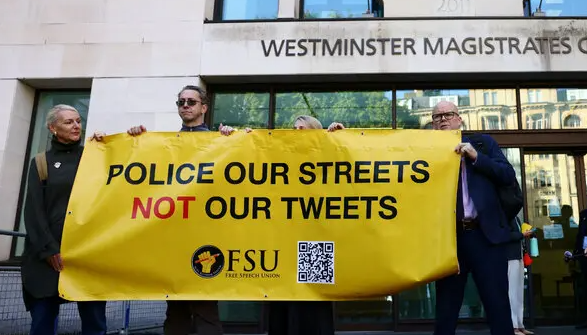
Many of us in Britain still flatter ourselves that we live in a free country. Although the UK isn’t quite a police state (not yet anyway), neither is it a country in which the individual can any longer speak without glancing over his or her shoulder. The old compact of a liberal society was simple – the state punished genuine criminality, while opinion was left to the rough justice of argument, satire and public disagreement.
That compact has now been comprehensively torn up. Across Britain, speech that would once have been answered by rebuttal or humour is now treated as a matter for police, regulators and secretive Whitehall machinery. A report published this week by civil liberties and privacy campaigning organisation Big Brother Watch states that more than 62,000 people in the United Kingdom were arrested for communications offences over a five year period, with at least 18,500 charged and 12,292 convicted. These numbers should alarm anyone who still believes the citizen is master and the state is servant.
This is not some marginal administrative adjustment. It is the apparatus of speech control operating on an industrial scale. Some cases will involve genuine threats – stalking, domestic abuse or harassment – and those cases should, of course, be investigated. But when arrest numbers vastly outstrip those of conviction, as is highlighted in the report, it is clear the process itself has become the punishment. The knock at the door, the search, the device seizure, the interview, the stigma, the potential loss of employment and the unmistakable lesson to everyone watching – keep quiet.
Worse, enforcement appears completely arbitrary. Big Brother Watch has described a “postcode lottery” of speech policing, with sharply different arrest rates between forces. Cumbria was reported as arresting people at dramatically higher rates than neighbouring Northumbria (although Cumbria Police has history when it comes to ‘woke’ policing). Liberty which varies by postcode is not liberty at all. It is permission, granted or withheld by local institutional mood. If the same national law produces radically different policing outcomes, the law is either too vague to restrain power or too tempting for power to resist.
The root of the problem lies in modern speech law and its elasticity. The Crown Prosecution Service guidance on communications offences covers offences under the Malicious Communications Act 1988, the Communications Act 2003 and Part 10 of the Online Safety Act 2023, including offences involving false or threatening communications. The framework encompasses messages said to be “grossly offensive”, “indecent”, “obscene” or “menacing”. Those words may sound reassuring in a statute book, but in the hands of ideological bureaucracies they become draconian tools to subdue inconvenient perspectives.
Recent cases expose the rot. In Hertfordshire, Rosalind Levine and Maxie Allen were arrested after complaints about their daughter’s primary school appeared in a parents’ WhatsApp group. They were held for eleven hours on suspicion including harassment and malicious communications. Hertfordshire Police later admitted the legal criteria for arrest were not met and agreed to pay them £20,000 in compensation. This is what happens when public bodies discover that the police can be weaponised as a complaints department with handcuffs.
The same authoritarian drift is visible with the now notorious notion of the Non-Crime Hate Incident. The clue is in the name – no crime has been committed. Lawful speech has been recorded by police in a way that brands ordinary people with a quasi-criminal stain. The College of Policing has now proposed major reforms, explicitly recognising that lawful free speech is not a police matter and that personal data should be recorded only where there is a clear policing purpose. That admission matters. It is an institutional confession that the state wandered far beyond its proper boundary – although it remains to be seen how police senior management across the country, many of whom are politically motivated, interpret these reforms.
My final role in policing involved facilitating the removal of terrorist content from the internet. This consisted of clear, unequivocal material glamourising proscribed groups, often including graphic footage of combat and the murder of captives. However, we began to notice that we were being tasked increasingly to assess content which was much more subjective: not violent or calling for violence, but ‘hateful’ – and only if viewed from a very specific point on the philosophical spectrum. This became more apparent with the establishment of police hate crime teams, and the fact that pursuing a nebulous ‘far Right’ was something which could gain one significant career advantages.
Then there is the darker machinery of government itself. Big Brother Watch’s ‘Ministry of Truth’ investigation alleged that secretive Whitehall counter-disinformation units monitor lawful political dissent online, including politicians, journalists, academics, campaigners and members of the public. In counter-terrorism policing, we were aware of the existence of some such units, but it is now clear this operation is much more extensive and that it runs much deeper than at first thought.
The public are told this is all about ‘misinformation’, but it has drifted into monitoring criticism of government policy. This is how censorship grows in a democracy – not with bonfires of books, but with dashboards, ‘trusted-flagger’ relationships, ‘narrative’ reports and officials quietly nudging platforms to reduce the reach of inconvenient opinions.
The Online Safety Act has only exacerbated the danger by shifting censorship pressure onto content service providers. Defenders say it targets illegality and protects children. Yet the predictable and inevitable result of duties, regulatory risk and political panic, is over-removal. Platforms don’t need to be commanded in plain language to censor; they need only be made afraid. Risk-averse companies will hide lawful speech, demand identity checks, throttle debate and call it compliance. The censor’s hand now often wears a corporate glove, especially if advertising revenue streams are threatened.
A serious country punishes tangible threats, criminality and violence. It doesn’t send the police after off-colour jokes, parental complaints or political dissent. We have to choose. We can choose to remain a liberal democracy in which the state respects the citizen, or we can become a managerial state in which the citizen fears a file, a knock on the door, a call from an online safety team or the quiet downgrade of their opinions.
Speech offences need to be drastically narrowed to those which call for direct violence or harm; ideological intelligence-gathering against lawful expression should be abolished; regulators ought to be restrained, and government content-flagging outside the terrorist space must be transparent.
Free speech isn’t a courtesy extended by ministers, chief constables or Silicon Valley compliance teams. It is the condition of citizenship in any civilised country. Without it, liberty is just a word in the dictionary.
Paul Birch is a former police officer and counter-terrorism specialist. You can read his Substack here.


Discussion
Comments
This week across the site:
To join in with the discussion please make a donation to the Daily Sceptic.
Profanity and abuse will be removed and may lead to a permanent ban.
A lot of the time the vast majority of people don’t know the first thing about the account that someone used to say something someone found offensive. How does anyone reading this know if Matt Dalby is my real name? The same applies to Facebook, X etc accounts. If Matt Dalby is my real name there might be more than one person in the UK with this name, which Matt Dalby made the comment someone thought was offensive? How do the vast majority of people know where the person using an account lives and which police force to report it to? The Daily Sceptic knows a bit about me because my account can be linked to the card I used to make a payment which can be linked to a bank account and therefore a real person, could the police force them to hand over my card details? Obviously with X etc where people don’t need to subscribe in order to make comments there isn’t this link from an account to a real person.
It seems to me that the vast majority of people who get investigated for something they said online must of been snitched on by someone they… Read more »
I have no doubt that the government and police could force the Daily Sceptic, FSU or anyone else to disclose your name, email address etc if they considered a comment harmful or likely to make anyone with “protected characteristics” “anxious” or “feel unsafe”.
Anyone who goes on X will have had a message warning of “Changes to Terms of Service”.—–In the UK and EU there will be changes starting on the 26th October whereby if posts and comments are deemed “unsafe” or “harmful” then those on the Platform may face having their posts removed, or accounts suspended etc etc.
This is pretty chilling actually. What does “harmful” actually mean? It can mean anything at all that anyone wants it to mean. It is so vague that no person could ever know that what they are about to post might be in danger of being classed as “”harmful. ——So effectively there will be carte blanche for the removal of posts and suspensions for the most frivolous reasons. Making it worse is the fact that it will be algorithms and not humans making the decision, and if anyone has tried arguing with an algorithm they will know what a waste of time that is.
I do not think that Musk really wants to do this, or why does it not apply to the USA?
I suspect the UK and EU may have threatened to ban X and he has been forced into this action. —-Any… Read more »
I noticed the other day when I called someone an idiot (they had acute symptoms of a chronic case of TDS) on Youtube that they asked me if I wanted to rephrase my comment before posting. I didn’t so it got posted. Waiting for a 4am knock on the door from plod now.
They can’t be. Most were empowered by statute as ‘independent’ regulators. The only way out of that is for a government with sufficient power and the necessary will to change the law and bring the responsibility back to elected representatives.
Changing the electoral system to PR would block that ability. PR is designed to prevent any majority governing.
Why do we need “regulators”? I don’t want anyone “regulating” what information, content , opinions, speech I am able to access.
I’m very pleased and proud that my FSU badge arrived this week to confirm my membership.
If in a general election the voting public are only allowed to vote for parties that have been approved by the state, the state and its agencies gain no information about how the public perceives them and their performance at governing.
Allow the public to vote for any party, and the more people who do cast a vote, this provides the state with valuable intelligence about what sort of opposition is building up and where.
The same applies to free speech. Make the public cautious about expressing dissent and the state and its agencies will gather no information about what opposition they face. If the public are encouraged – nudged – into expressing approved narratives and laundered morality, the state is completely in the dark.
This sycophancy induced with arrests and handcuffs is not conversion to the approved beliefs. It is likely to produce resentment. And along with money, resentment is one of the other things that makes the world go round.
The British state might look to the example of the Ceausescu husband and wife team. Believing that they were beloved by their public, when they appeared on the balcony of the presidential palace and waved at… Read more »
Free speech isn’t a courtesy extended by ministers, chief constables or Silicon Valley compliance teams.
Given that the number of convictions are vastly smaller than the number of arrests in this example in the UK, it is evident that the ‘authorities’ believe that free speech is a mistake.
And what of the organisations that are happy to use the police to intimidate people who criticise them? Or the senior officials in banks who de-bank customers who have dissident views? None of the people who do this can believe in free speech.
Belief in free speech among the general public may be much less than the Free Speech Union thinks.
Totally agree especially your last sentence. Most people I know say they believe in it but when I posit whether some “hateful” opinions should be allowed they say “ah well of course there are limits..”.
States have never tolerated their populations challenging their legitimacy.
The problem we are encountering is that when a state becomes increasingly totalitarian as ours is – and by that I mean that it increasingly dictates how we must behave and conduct our lives – then the things that constitute a challenge to its legitimacy also increase.
This is the result of an out of control state bureaucracy, with no practical effective limits to its power. It now considers itself entitled to impose certain ideological beliefs on us and it compulsively churns out rules, regulations and “guidance’.
The 62,000 are people suffocating, gasping for air.
The destruction of free speech isn’t an accidental result of a changing political culture – it is the necessary component of a very evil project: The Great Replacement. This is why our rulers have to shut us up. This is why we’re not allowed to object to the importation of the Establishment’s beloved criminals, rapists, and murderers. This is why we’re not allowed to point out the absurd lie of “diversity is our strength”. It’s clear that if diversity really did strengthen our people, our rulers would oppose it. The ruling class of our country is decadent, degenerate, and deranged; and it has to be changed.
Yes I do find it instructive that the quickest ways to get cancelled or prosecuted are for “racism”, “islamophobia” or anything strongly anti-immigrant/immigration.
Isn’t it funny how no one criticises Japan or Saudi Arabia, or Poland, Hungary and many many other countries for not allowing hundreds of thousands of migrants to enter their countries? —-Only Western Countries are taking them. —Why?
Yes and wouldn’t the country be in great shape if it really were our strength!
“With 62,000 people arrested for speech crimes in five years, the UK can no longer claim to be a free society”
Race Relations Act 1965 created the offence of “incitement to racial hatred”.
Does the state own us or do we own the state? The answer used to be obvious – the question wasn’t worth asking. Now it is.
The state owns us. But tells us we own it.
Most believe it. Some of us don’t.